

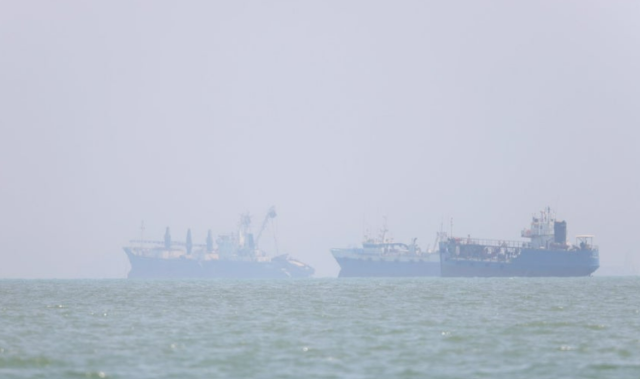
Despite a tentative agreement on a ceasefire memorandum of understanding (MOU) between the United States and Iran, clashes have continued in the Strait of Hormuz.
According to Yonhap News on June 13, the U.S. Central Command (CENTCOM), which oversees military operations in the Middle East, reported via social media platform X on June 12 that "Iran launched several one-way attack drones (kamikaze drones) to target commercial vessels passing through the Strait of Hormuz," adding that "U.S. forces shot down all of these drones in recent hours."
CENTCOM emphasized that "shipping traffic through the strait continues without disruption," stating that "international trade routes remain open."
The command also noted that "U.S. forces are maintaining their presence and readiness in the region, with F-16 fighter jets patrolling the skies over the Middle East."
Iran's semi-official Mehr News Agency reported explosions detected near the southern Iranian port of Sirik and the island of Qeshm.
Even as the U.S. and Iran prepare to sign the ceasefire MOU, confrontations in the Strait of Hormuz persist. Iran is attempting to exert control by launching drone attacks on commercial vessels passing through the strait without approval from its military. In response, U.S. forces continue to shoot down Iranian drones that threaten these vessels.
Previously, Iran had formalized its stance to maintain control over the Strait of Hormuz, indicating it would ultimately seek to impose a 'toll' on vessels transiting the area, even after the signing of the ceasefire MOU with the U.S.
Iranian Foreign Minister Abbas Araghchi stated on Iranian state television that "the management of the Strait of Hormuz will not revert to the pre-war state," reiterating the intention to impose a 'service fee' on ships passing through the strait.
* This article has been translated by AI.
Copyright ⓒ Aju Press All rights reserved.