

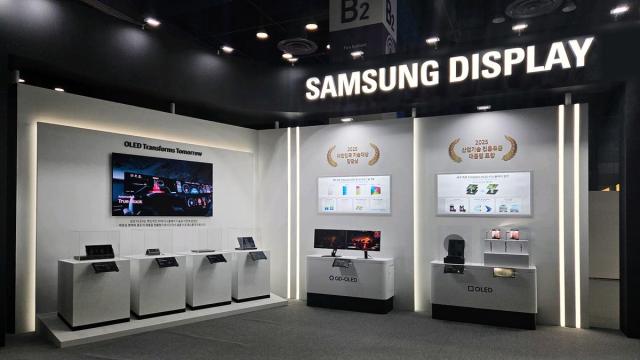
As China's pursuit of organic light-emitting diode (OLED) technology intensifies, experts are calling for urgent government support to maintain South Korea's technological leadership. To avoid repeating the mistakes of the past when South Korea lost its dominance in the liquid crystal display (LCD) market to China, significant investment in research and development (R&D) and facility upgrades is deemed essential.
A report released on June 14 by the Korea Eximbank's Economic Research Institute indicates that last year, Samsung Display and LG Display held a combined market share of 68.7% in the global OLED market, while China accounted for 31.2%.
The gap in market share between the two countries has been narrowing significantly each year. In 2020, South Korea held 87.3% of the market compared to China's 12.1%, a difference of 75.2 percentage points. By 2023, this gap had decreased to 47.9 percentage points, then to 34.9 percentage points in 2024, and finally to just over 30 percentage points last year.
The report suggests that Chinese companies are replicating the 'chicken game' strategy they used to dominate the LCD market, which involves aggressive price competition. South Korea maintained its position as the global leader in the LCD market for 17 years until 2021, when it lost its edge to China's subsidized low-cost production.
The competition is now extending beyond smartphones into high-value sectors such as information technology (IT) device panels. The technology gap in IT OLED capabilities, previously estimated at three to four years, has reportedly shrunk to about two years.
Chinese firms, including BOE, are increasing their supply of low-cost panels to domestic smartphone manufacturers, thereby expanding their influence in the small and medium-sized OLED market. Last year, China's share of the small and medium-sized OLED market, including smartphone applications, surged to 35.9%, putting pressure on South Korea's 64.0% share.
Despite these challenges, the report notes that the order-based structure of the OLED market makes it difficult for short-term price pressures to significantly alter the competitive landscape. The establishment of a fair patent licensing structure by South Korean companies is seen as a positive factor.
However, to counter the large-scale production efforts and technological advancements backed by the Chinese government, South Korea must implement robust policies, including tax incentives and financial support.
The Economic Research Institute warns, "While South Korea still holds an advantage in mass production technology and quality, China's aggressive investments continue. If domestic companies slow their R&D efforts even momentarily, there is a significant risk of losing ground in the OLED market."
* This article has been translated by AI.
Copyright ⓒ Aju Press All rights reserved.