

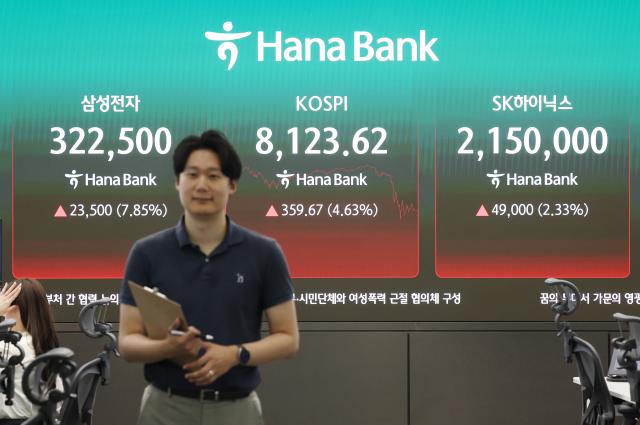
The KOSPI, South Korea's main stock index, is experiencing unprecedented highs, but the performance of individual stocks is sharply divided. The number of stocks reaching 52-week highs is nearly equal to those hitting 52-week lows.
According to statistics from the Korea Exchange, as of June 12, out of 2,875 listed stocks, 1,508 have recorded 52-week highs since the beginning of the year, including 545 on the KOSPI.
Large-cap stocks have driven the index's rise, with major players like Samsung Electronics and SK Hynix leading the way. Most of the top 10 stocks by market capitalization, including SK Square, Samsung Electronics Preferred, Hyundai Motor, Samsung Electro-Mechanics, Samsung Life Insurance, Samsung C&T, and HD Hyundai Heavy Industries, reached new 52-week highs between late last month and early this month, with the exception of LG Energy Solution.
Conversely, during the same period, 1,763 stocks recorded 52-week lows, surpassing those that achieved highs. Among these, 530 were KOSPI stocks and 1,172 were KOSDAQ stocks.
Notably, 587 stocks, or 20.4% of all listed companies, have experienced both highs and lows this year. This means that one in five listed companies has faced significant fluctuations. The volatility was particularly pronounced among small and mid-cap stocks, with 192 KOSPI stocks and 383 KOSDAQ stocks affected.
Samsung Biologics is a prime example among large-cap stocks. It reached a 52-week high on January 15 but subsequently fell, hitting a low on June 8. The company's market capitalization briefly rose to fourth place after announcing a presentation at the JP Morgan Healthcare Conference, but it later relinquished those gains.
Theme stocks have also shown high volatility. SJ Group, which gained attention as a theme stock related to the Seoul mayoral election, reached a high in February but fell to low levels after the election as investor sentiment waned. In contrast, Seoul Semiconductor, which recorded a 52-week low in January, rebounded to a new high last month amid improving expectations for the semiconductor market.
Lee Jae-won, a researcher at Yuanta Securities, stated, "The current volatility has not been fully resolved. Next week’s meetings of major central banks, including the U.S. Federal Reserve and the Bank of Japan, could contribute to market fluctuations."
However, he added, "As long as the upward trend driven by AI remains intact, a focused response centered on earnings stocks will continue. Unless major central banks take sudden, aggressive hawkish actions, market sentiment is likely to transition smoothly into the second quarter, which is showing strong export and price growth results."
* This article has been translated by AI.
Copyright ⓒ Aju Press All rights reserved.