

Symbolic journeys have always marked significant turning points in world history. Christopher Columbus's transatlantic voyage opened the age of the New World, Deng Xiaoping's southern tour determined the direction of China's reform and opening, and Steve Jobs's iPhone announcement ushered in the smartphone era. Similarly, Jensen Huang's recent tour of Taiwan and South Korea in late May and early June 2026 is likely to be recorded as a crucial milestone in the history of the AI industry.
Many people focused on Huang's visits to night markets in Taiwan and his enjoyment of samgyeopsal in South Korea, with media outlets highlighting his culinary experiences and personal charm. However, for those attuned to global industrial trends, a different scene emerged: the supreme commander of the world AI empire inspecting his core production and logistics bases in a massive supply chain tour.
The first stop that drew attention was Taiwan. Today, NVIDIA stands at the center of the AI industry, and Taiwan is at the heart of NVIDIA's operations. Most of the cutting-edge GPUs designed by NVIDIA are produced at Taiwan's TSMC. NVIDIA's Blackwell and Rubin platforms, in fact, could not exist without Taiwan's advanced semiconductor manufacturing capabilities.
Huang's closest meetings in Taiwan were with TSMC. TSMC is not just a foundry; it is the heart of the global semiconductor industry. Major fabless companies, including Apple, AMD, Qualcomm, and Broadcom, all rely on TSMC for their AI chips. If NVIDIA is the emperor of the AI era, TSMC can be seen as the empire's forge producing weapons for the emperor.
Huang also maintains close partnerships with Taiwan's AI server manufacturers, including Foxconn, Quanta, Wistron, Inventec, and Pegatron. While these companies may be less familiar to the general public, they are absolute giants in the global data center industry. A significant portion of the AI servers equipped with NVIDIA GPUs are produced in their factories. This is why it is said that the actual production site of the AI industry is not Silicon Valley but Taiwan.
Foxconn, in particular, is no longer just an iPhone assembly company. It has expanded its business into AI servers, robotics, and electric vehicles, preparing for the era of Physical AI. Quanta has also grown to become one of the world's largest AI server manufacturers. Ultimately, Taiwan has established a complete manufacturing ecosystem that brings NVIDIA's brain to life.
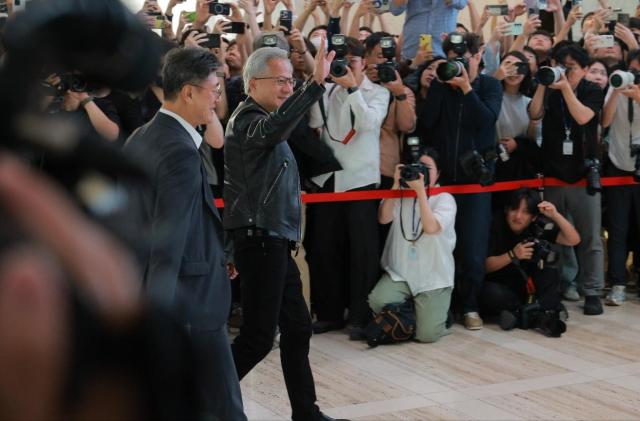
In contrast, the companies Huang met in South Korea play a different role. South Korea is not the country that creates the brain of the AI industry; rather, it supplies the blood that fuels it.
At the center of this supply is SK Hynix. Currently, SK Hynix is virtually the strongest player in the HBM market for NVIDIA's AI servers. HBM is a critical component that connects GPUs and data at ultra-high speeds. No matter how advanced a GPU is, it cannot function properly without sufficient HBM. Therefore, one of the biggest bottlenecks in today's AI industry is the supply of HBM.
Huang's visit to SK Hynix was not merely a formality; it was a process of confirming the lifeline of the AI industry. In fact, many of NVIDIA's latest platforms heavily rely on SK Hynix's HBM. As AI data centers proliferate, SK Hynix has become one of NVIDIA's most important strategic partners.
Samsung Electronics was also a key stop on Huang's visit. As the world's leading memory company, Samsung is fiercely competing with SK Hynix for the next-generation HBM4 market. For NVIDIA, diversifying its supply sources is essential. Therefore, the quality certification of Samsung's HBM and the potential for supply expansion will directly impact the stability of the future AI supply chain.
Another noteworthy company during the South Korea visit was Hyundai Motor Group. This is a significant signal. While Hyundai is an automotive company, it is attempting to transform into an AI-based mobility company. Autonomous vehicles, robotics, and smart factories are all core areas of Physical AI. NVIDIA is also focusing on developing AI platforms for vehicles and robotics. The collaboration between Hyundai and NVIDIA is not just a partnership in automotive technology; it is more akin to building a testing ground for future industrial revolutions.
LG Group is another entity to watch. LG has potential collaboration opportunities with NVIDIA across various areas, including batteries, electric components, smart factories, and AI data center cooling technologies. As AI becomes more integrated into the real world, the importance of power, batteries, cooling, and sensor technologies increases.
Naver also emerged as an interesting visit. Until now, South Korea has been a stronghold for AI semiconductors but not for AI platforms. Naver is building a Korean version of generative AI through HyperCLOVA and is working to secure competitiveness in the data center and cloud sectors. Huang's meeting with Naver can be seen as a process of confirming the potential of the entire Korean AI ecosystem, not just meeting a customer.
Thus, Taiwan and South Korea play different roles in NVIDIA's supply chain. While Taiwan serves as the manufacturing hub for the AI industry, South Korea acts as the memory hub. If Taiwan is NVIDIA's arms and legs, South Korea can be seen as its veins.
However, an important question remains: Will South Korea remain a memory supplier, or will it become a co-designer of AI civilization?
Taiwan has already seized control of the entire manufacturing ecosystem. The United States dominates platforms and software. China is catching up with its vast market and state-led AI strategy. Now, South Korea must also move to the next stage.
The next stage is Physical AI.
The reason Huang met with Hyundai, LG, and Naver in South Korea ultimately relates to this. The future of AI lies not within data centers but in factories, warehouses, hospitals, farms, vehicles, and robotics. As a manufacturing powerhouse, South Korea has advantageous conditions in this field compared to the United States.
In particular, Jeonbuk and Saemangeum hold new possibilities in the era of Physical AI. Their vast industrial land, renewable energy, agricultural biotechnology, and manufacturing base provide suitable conditions for building AI demonstration cities. In the future, the center of the AI revolution is likely to shift from mere semiconductor production to Physical AI that drives actual industrial sites.
Thus, Jensen Huang's tour of Taiwan and South Korea is not just a business trip record. It serves as a preview of the second act of the AI revolution. In Taiwan, he confirmed the power of the AI manufacturing empire, while in South Korea, he assessed the potential of the AI application industry.
We may remember the samgyeopsal and soju, but Huang saw HBM, robotics, autonomous driving, and Physical AI. While we recall laughter and handshakes, he calculated supply chains, markets, and the industrial map for the next decade.
The true competition of the AI era has just begun. This tour was the first test of whether South Korea can transcend its role as a mere supplier and become a key player in AI civilization.
* This article has been translated by AI.
Copyright ⓒ Aju Press All rights reserved.