SEOUL, June 15 (AJP) - Researchers in South Korea have developed a technique to transfer microscopic electronic circuits onto delicate surfaces by floating metal components on water. This opens new possibilities for wearable devices and biological sensors, the Korea Advanced Institute of Science and Technology said Monday.
The technique, called water-floated nanotransfer printing, removes the need for heat, pressure, toxic chemical solvents, or adhesives. This allows the circuits to be applied to biological tissues or complex shapes that would normally be damaged by traditional methods. The research was led by the Korea Advanced Institute of Science and Technology (KAIST)'s Professor Park In-kyu, in collaboration with Dr. Jung Jun-ho from the Korea Institute of Machinery and Materials (KIMM) and Professor Ahn Jun-sung from Korea University.
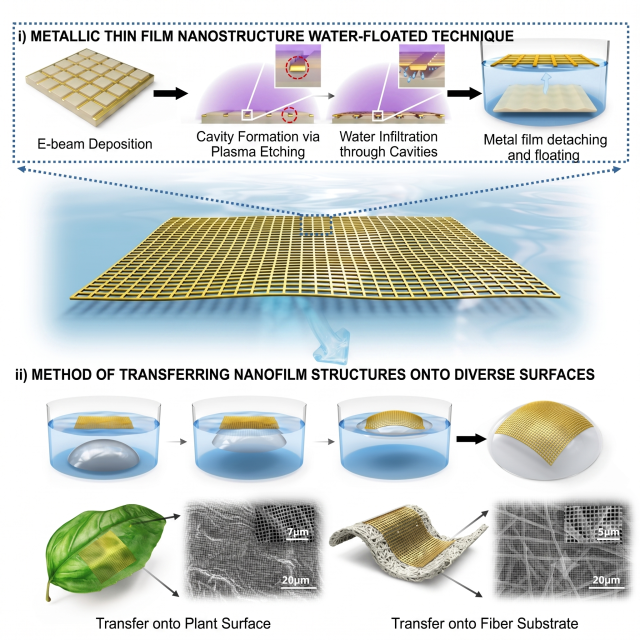
To create the floating circuits, the research team places an extremely thin layer of metal, such as gold or platinum, onto a polymer template. They use an ionized gas plasma to remove specific parts of the template. When placed in water, the liquid moves into small gaps, allowing a 20-nanometer-thick metal film to separate and float on the surface while keeping its shape.
The circuits are transferred by dipping an object under the floating metal film and slowly scooping it up. As the water dries, the physical force of the liquid pulls the circuit tightly against the object, and natural molecular attraction keeps it attached without glue. The team also used the method on water-repellent surfaces, such as lotus leaves, by adding a small amount of ethanol to lower the surface tension of the water.
The researchers tested the technology by creating sensors directly on lemons and oranges to detect small amounts of a pesticide. They also moved a metal mesh onto stretchable fibers to create a wearable gas sensor. The study, with KAIST doctoral candidate Kang Byung-ho as the lead author, was published in the journal Nature Communications on March 30, 2026.
"This technology is significant because it overcomes the substrate limitations of existing nanotransfer printing, allowing nano patterns to be transferred to sensitive surfaces like living plant leaves or skin without adhesives or heat," Professor Park In-kyu said. "It can be utilized in various fields, from smart agriculture that measures pesticides without damaging crops to wearable health monitoring devices, bioelectronics, and next-generation robotic electronic skin, and is expected to develop into a core platform technology for wearable sensors and bioelectronics in the future."
(Reference Information)
Journal/Source: Nature Communications
Title: Versatile water-floated nanostructures for three-dimensional nanotransfer printing
Link/DOI: https://bit.ly/4e9s0h5

Copyright ⓒ Aju Press All rights reserved.