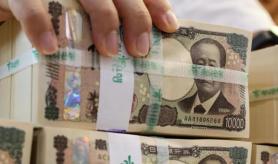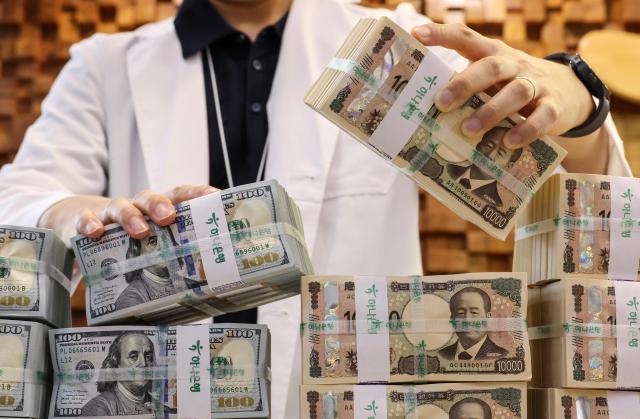
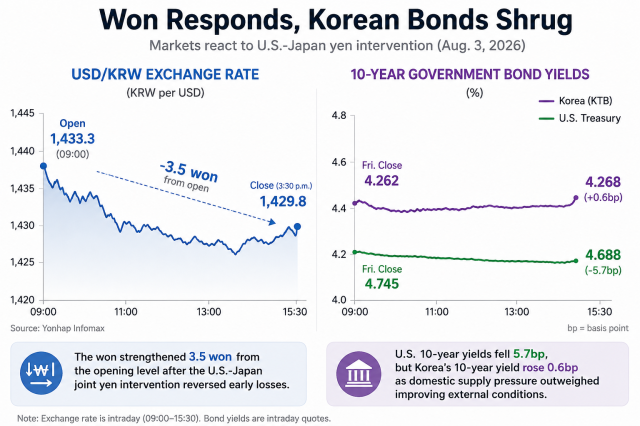
The won closed at 1,429.8 per dollar at 3:30 p.m. Monday, strengthening 3.5 won from its opening level of 1,433.3 after the coordinated intervention helped reverse its early losses.
The currency has appreciated more than 8 percent over the past month, far outpacing the dollar index's 1.3 percent decline and the Japanese yen's 1.4 percent gain during the same period.
By contrast, the benchmark 10-year Korean government bond yield was quoted at 4.268 percent in late-afternoon trading, 0.6 basis point above Friday's close after briefly falling to 4.247 percent earlier in the session.
The divergent moves underscored that the intervention has become a far more powerful driver for foreign exchange than for Korea's longer-dated government bonds.
U.S. Treasury Secretary Scott Bessent said Washington was prepared to participate in additional intervention if necessary, helping the yen rebound after it neared 164 per dollar.
Although Korea was not directly involved, the operation significantly raised the risk of maintaining bearish positions against Asian currencies that had traded largely as proxies for the yen.
The won had already strengthened sharply in July as dollar inflows increased following SK hynix's ADR offering, exporters stepped up dollar conversions and the Bank of Korea raised interest rates, narrowing the policy gap with the Federal Reserve.
The currency appreciated 8.81 percent during July alone, its strongest monthly gain since March 2009, ending the month at 1,424 after beginning at 1,549.4.
Most economists now see the won testing 1,400 in coming months, although views diverge over whether the rally can be sustained into year-end.
Kim Seo-jae, an economist at Shinhan Bank, expects the won to strengthen beyond 1,400 during the third quarter before weakening again in the fourth quarter as large U.S. IPO-related dollar demand returns and expectations for additional Federal Reserve tightening potentially re-emerge.
Taken together, the forecasts suggest the intervention has materially improved the won's near-term outlook without guaranteeing that overseas investment flows and U.S. monetary policy will not eventually reassert themselves.
The bond market responded far less enthusiastically because domestic supply and monetary policy remain the dominant drivers of longer-term yields.
A stronger won reduces imported inflation and eases pressure on the Bank of Korea to tighten policy simply to defend the currency, providing greater support to short-dated bonds.
Longer maturities, however, remain hostage to domestic issuance.
The government auctioned 3.3 trillion won of two-year bonds Monday and is scheduled to sell another 2.8 trillion won of 30-year bonds Tuesday as part of August's 17 trillion won borrowing program.
The approaching long-bond auction, combined with profit-taking after Friday's rally, kept investors cautious despite lower U.S. Treasury yields.
Korea's benchmark 10-year government bond yield climbed 16.6 basis points during July after the Bank of Korea's first rate increase of the cycle and policymakers signaled additional tightening to curb inflation and speculative leverage.
Meanwhile, U.S. Treasuries rallied, with the benchmark 10-year yield falling 5.7 basis points to 4.688 percent and the 30-year yield declining 4.2 basis points to 5.233 percent.
The contrast illustrates that declining U.S. yields alone were insufficient to overcome Korea's immediate supply overhang.
The Treasury angle
The intervention also carries broader implications for global bond markets because Japan remains the largest foreign holder of U.S. government debt, with $1.143 trillion of Treasuries at the end of May.
Large-scale yen intervention has historically raised concerns that Tokyo could finance dollar sales by liquidating Treasuries, putting upward pressure on global yields.
Bessent sought to address those concerns by supporting wider use of the Federal Reserve's Foreign and International Monetary Authorities Repo Facility, which allows foreign central banks to obtain temporary dollar liquidity by pledging Treasuries as collateral rather than selling them outright.
Greater use of the FIMA facility would enable Japan to fund future intervention while minimizing disruption to the U.S. Treasury market.
That, in turn, could help contain upward pressure on long-term global yields and eventually benefit Korean government bonds through international rate linkages, although domestic issuance and Bank of Korea policy would likely remain the primary determinants of local yields.

Copyright ⓒ Aju Press All rights reserved.