


Overseas-focused products accounted for 40.5 percent of ETFs launched since July, up from about 27.3 percent in the first half of the year, according to Korea Exchange data. Of 37 ETFs listed since July, 15 were tied to overseas assets.
The reversal follows a dramatic swing in the Korean stock market.
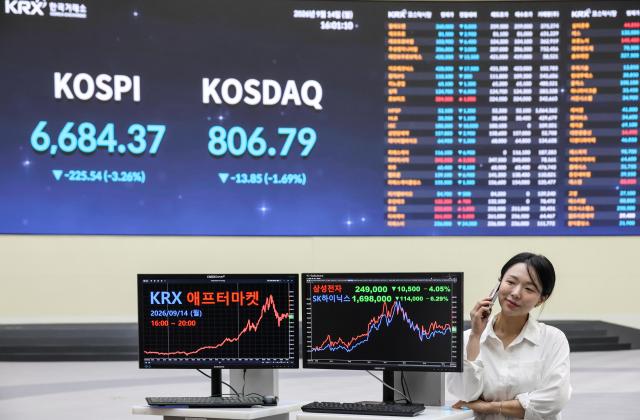
The KOSPI climbed above 9,000 for the first time in the first half before retreating into the 6,000s after late June. The index spent much of the past three months in that range, briefly reclaiming 7,000 on Sept. 9 before slipping back two days later.
Monday brought another attempt at breaking out. The benchmark rose 1.65 percent to close at 7,007.72, reclaiming 7,000 after seven trading sessions.
"There is a considerable possibility that the 6,000 level could become a new trading range," said economist Kim Dae-jong of Sejong University.
"The KOSPI is likely to show considerable volatility around 6,000 depending on semiconductor earnings, U.S. interest rates and stocks, and foreign investor flows," he said.
The latest rebound does not rule out continued volatility around the 6,000 level, Kim added.
Individual investors are also debating whether it is time to look abroad again.
"Looking at the S&P 500 after watching the KOSPI puts my mind at ease," one investor wrote on a Naver stock community site.
Another was wary of simply shifting losses from one market to another.
"People who got burned in the Korean market are rushing into U.S. stocks, but they could end up getting burned there too," the user wrote.
The mood is a sharp reversal from the first half, when the heat was concentrated in the KOSPI and domestic chip-related products.
Last year, 109 of 168 newly listed ETFs, or 64.8 percent, focused on overseas assets. The share reached 81.9 percent in the first half of 2025 before falling to 52.0 percent in the second half as Korean equities gathered momentum.
The rotation continued into the first half of 2026, when the KOSPI surged through 9,000 and the overseas share of new ETF listings fell to about 27.3 percent.
Momentum shifted again after late June.
Four of the nine ETFs listed so far in September, or 44.4 percent, invest in overseas assets. For the year through Sept. 18, 42 of 136 newly listed ETFs were overseas-focused, accounting for 30.9 percent of the total.
Of the 99 products listed in the first half, 27 focused on overseas assets. The number was 15 out of 37 from July through Sept. 18.
"Both investors and asset managers are broadening their investment scope toward global markets as Korean stocks undergo a correction," Kim said.
Weaker momentum in Korean equities could keep some investor money flowing toward overseas ETFs for some time, he added.
The changing appetite is also visible in the size of two of the country's biggest equity ETFs.
At the end of June, KODEX 200, which tracks large Korean stocks, had 28.82 trillion won ($20.8 billion) in net assets, more than 8 trillion won above the 20.03 trillion won held by TIGER U.S. S&P 500.
By Sept. 17, KODEX 200's net assets had fallen 14.4 percent to 24.65 trillion won. TIGER U.S. S&P 500 grew 2.5 percent to 20.55 trillion won, narrowing the gap between the two funds to about 4.1 trillion won.
Asset managers are following the money with another crop of products built around U.S. technology and global growth.
NH-Amundi Asset Management listed HANARO U.S. Agentic AI TOP2+ ETF on Sept. 15, targeting U.S. companies linked to agentic AI.
Samsung Asset Management launched KODEX U.S. AI Memory TOP2 Plus ETF on the same day, focusing on U.S. memory and data-storage companies.
Mirae Asset Global Investments introduced TIGER U.S. S&P 500 U.S. Treasury Mixed 50 ETF on Sept. 8, splitting its portfolio between the S&P 500 and short-term U.S. Treasuries.
KB Asset Management listed RISE Global AI NAND Memory Semiconductor ETF on Sept. 1, investing across the Korean and overseas NAND memory supply chain.
"If Korean stocks continue to trade within a narrow range, asset managers are likely to actively launch products built around U.S. AI, semiconductors and global technology stocks," Kim said.
U.S. AI, semiconductors and data centers are likely to remain attractive because of their longer-term growth prospects, he added.
Monday's return above 7,000 could revive demand for Korean equity ETFs if the rebound holds.
The recent move overseas does not necessarily point to a lasting exodus from Korean assets. Stronger corporate earnings and renewed foreign buying could quickly bring domestic products back into favor.
"The ETF market is ultimately more likely to become more diversified across Korean stocks, U.S. AI and semiconductor shares, bonds and gold, rather than shift entirely toward either domestic or overseas assets," Kim said.
AJP Takeaways
- Overseas-focused ETFs accounted for 40.5 percent of new listings from July through Sept. 18, up from about 27.3 percent in the first half as the KOSPI lost momentum.
- The KOSPI returned above 7,000 Monday, closing 1.65 percent higher at 7,007.72 after spending much of the past three months in the 6,000 range.
- KODEX 200 net assets fell to 24.65 trillion won by Sept. 17 from 28.82 trillion won at the end of June, while TIGER U.S. S&P 500 grew to 20.55 trillion won from 20.03 trillion won.
- Economist Kim Dae-jong said prolonged KOSPI consolidation could encourage more products tied to U.S. AI, semiconductors and global technology stocks while the broader ETF market diversifies across domestic equities, overseas assets, bonds and gold.

Copyright ⓒ Aju Press All rights reserved.
