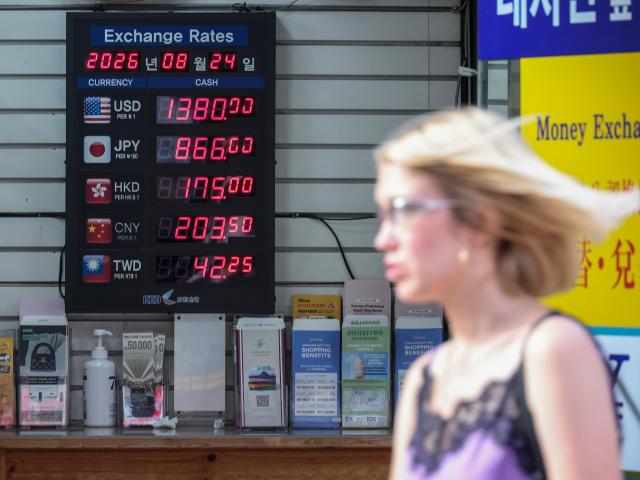
The won closed Monday at 1,381.0 per dollar, 2.3 won stronger than Friday, while China's yuan strengthened as far as 6.6957 per dollar, its strongest level in more than three and a half years.
U.S. Treasury yields remain near levels that have unsettled global debt markets, with the benchmark 10-year yield having breached 5 percent last week amid renewed inflation concerns, expectations for further Federal Reserve tightening and worries over America's mounting debt burden.
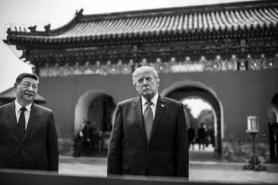
South Korean markets are therefore exposed on both fronts as U.S. President Donald Trump and Chinese President Xi Jinping prepare to meet in Washington on Sept. 24.
For the foreign-exchange market, the immediate link runs through the yuan.
The Bank of Korea found in a 2025 Issue Note that the Korean won had the highest degree of co-movement with the Chinese currency among 33 currencies examined.
The relationship weakened structurally after 2020 as Korea-China trade ties shifted and global supply chains were reorganized, but the BOK found the correlation had begun moving back toward its long-term average.
More importantly for markets, the relationship is asymmetric.
The won has historically moved more closely with the yuan when both currencies are weakening against the dollar than when they are appreciating, according to the BOK.
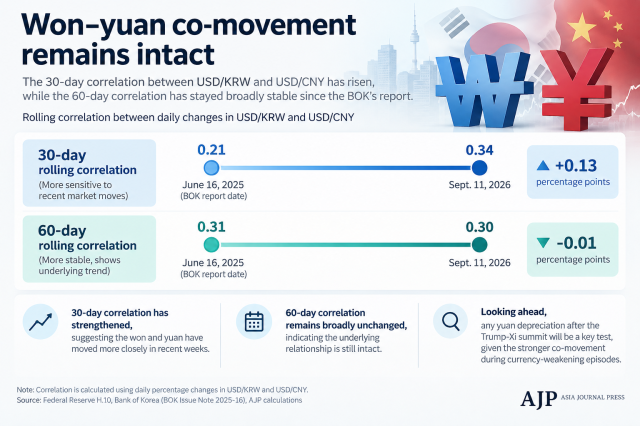
A summit outcome that reverses the yuan's recent strength would therefore carry particular weight for Seoul.
The Chinese currency strengthened to 6.6957 per dollar Monday after the People's Bank of China allowed its daily fixing to move closer to market expectations, easing resistance to appreciation ahead of the summit.
A continuation of the trend could provide some support for North Asian currencies. A renewed yuan decline, particularly if driven by trade friction or disappointment over the summit, would provide a more direct test of the won-yuan linkage identified by the BOK.
The won's movement would not be automatic.
Korea-specific factors, including semiconductor exports, exporter dollar selling, domestic interest rates and foreign investment flows, continue to influence the currency independently.
The BOK's findings nevertheless suggest the yuan remains one of the more important external variables for the won, particularly during bouts of dollar strength and risk aversion.
The second link runs through Washington's debt market.
U.S. federal debt has surpassed $40 trillion, while higher inflation and expectations for further Fed tightening have pushed Treasury borrowing costs sharply higher. The 10-year Treasury yield climbed above 5 percent last week for the first time since 2023.
Foreign demand for Treasuries has become increasingly important as Washington continues to issue large volumes of debt.
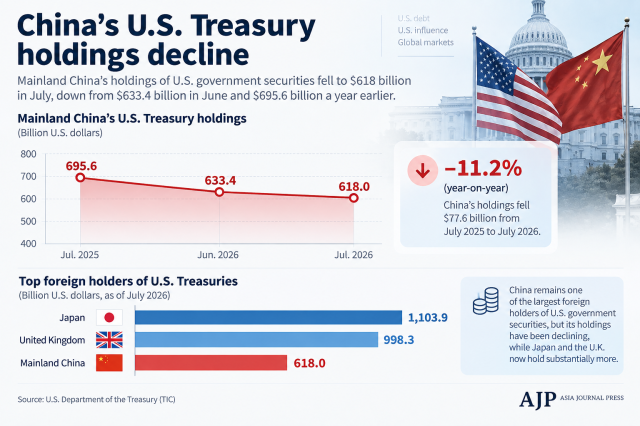
China remains one of the biggest foreign holders of U.S. government securities, although its holdings have been falling.
Mainland China's Treasury holdings declined to $618 billion at the end of July from $633.4 billion in June and $695.6 billion a year earlier, according to U.S. Treasury Department data. Japan and the United Kingdom now hold substantially more.
The publicly identified subjects center on trade, tariffs, purchases of U.S. goods, technology restrictions, artificial intelligence, critical minerals and geopolitical issues. Beijing is seeking relief from some technology curbs, while Washington is pressing for additional Chinese purchases of American goods.
Bond investors, however, will also watch for any signal that could affect China's willingness to hold U.S. assets.
An increase in Chinese Treasury demand, or even a slower reduction in its holdings, would tend to support bond prices and ease upward pressure on yields. Further reductions could add to concerns over demand at a time when U.S. borrowing needs are high.
The transmission matters directly for Seoul.
A Bank of Korea working paper released Sunday found that co-movement between Korean and U.S. long-term interest rates increased sharply during major global shocks.
The study found global inflation was the single largest contributor to the relationship, while Federal Reserve policy was another significant source of Korea-U.S. yield co-movement. External shocks were transmitted to Korean long-term yields mainly through expectations for future monetary policy rather than changes in risk compensation.
The Korean bond market entered summit week already caught between those forces.
The three-year Korean government bond yield rose 2.1 basis points to 4.056 percent at Monday's close, while the 10-year yield fell 0.9 basis point to 4.457 percent.
The movements followed another volatile week in global debt markets after the Federal Reserve raised its benchmark rate by 25 basis points to 3.75-4.00 percent and signaled scope for further tightening.
The summit therefore presents Seoul with two connected market tests.
Currency traders will watch whether the yuan can sustain its advance or turns lower after Trump and Xi meet, with the latter scenario historically posing the greater risk of pulling the won with it.
Bond investors will focus on whether the summit changes expectations for U.S. inflation, trade, fiscal pressure or foreign demand for Treasuries enough to move American yields.
No formal currency or debt agreement would be required for the summit to matter for Korea.
A shift in the yuan can travel quickly into the won, while a repricing of U.S. Treasuries can pass through to Korean long-term borrowing costs.
For Seoul markets, the most consequential outcome may ultimately be reflected in the price of China's currency and America's debt.
AJP Takeaways
- The won closed Monday at 1,381.0 per dollar as the yuan reached 6.6957, its strongest level in more than three and a half years ahead of the Sept. 24 Trump-Xi summit.
- The BOK found the won has the strongest co-movement with the yuan among 33 currencies, with synchronization particularly strong when the two currencies are depreciating.
- China's U.S. Treasury holdings fell to $618 billion in July as U.S. federal debt surpassed $40 trillion and the benchmark 10-year Treasury yield moved around 5 percent.
- A separate BOK study found strong Korea-U.S. long-term yield co-movement during global shocks, making Treasury yields a key transmission channel into the Korean bond market.

Copyright ⓒ Aju Press All rights reserved.