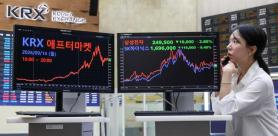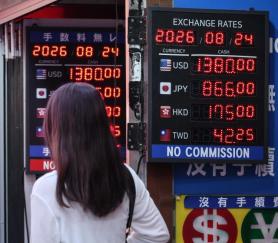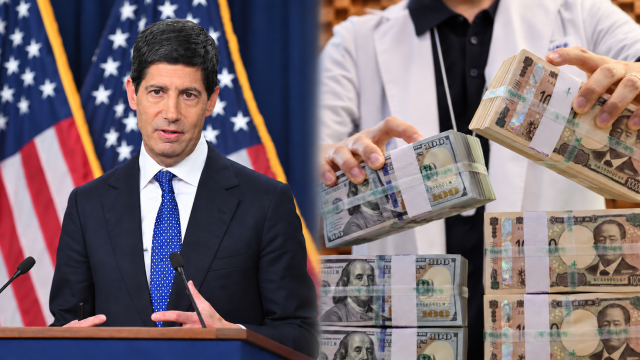
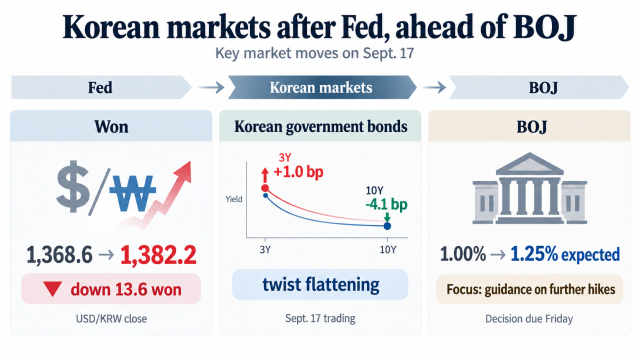
The won closed down 13.6 won at 1,382.2 per dollar from Wednesday's 1,368.6 after the Fed raised its benchmark rate by 25 basis points to 3.75-4.00 percent and signaled scope for another increase this year. The dollar climbed to a seven-week high after the decision.
The three-year Korean government bond yield rose 1.0 basis point to 4.063 percent, while the 10-year yield fell 4.1 basis points to 4.506 percent Thursday.
The gap between the two benchmarks narrowed to about 44.3 basis points from 49.4 basis points at Wednesday's close, flattening the yield curve.
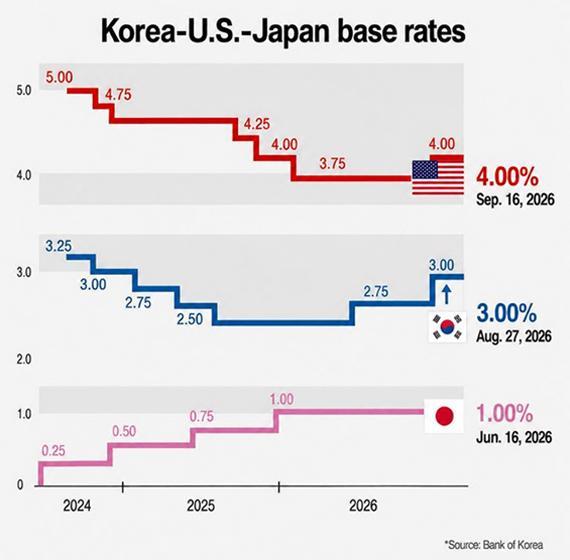
The BOJ is widely expected to raise its policy rate from 1 percent to 1.25 percent Friday, which would take the benchmark to a 31-year high. Attention has increasingly shifted to how Gov. Kazuo Ueda describes the timing and pace of subsequent increases.
All 52 economists surveyed by Bloomberg expected a September increase, with most anticipating additional hikes either every quarter or at intervals of four to five months, according to a Thursday report by IBK Investment & Securities researcher Kim Ye-seul.
Higher inflation risks and renewed yen weakness, which could raise import prices, were cited as reasons for continued tightening.
Markets had already priced in a greater than 90 percent probability of a September hike before the meeting, limiting the likely impact of the quarter-point move itself, MUFG Research said in a Sept. 14 report.
Ueda is expected to retain a data-dependent approach rather than commit to rapid consecutive increases, with the BOJ continuing to assess economic and inflation conditions before determining the timing and pace of further tightening, according to MUFG.
The yen weakened toward 156 per dollar Thursday after the Fed decision strengthened the U.S. currency, reversing part of an earlier advance driven by expectations of faster BOJ tightening.
A quarter-point BOJ increase alone may therefore offer limited support to the yen unless the central bank gives markets reason to expect a faster tightening path, according to analysts cited by Reuters.
The yen's direction after the BOJ meeting was listed alongside the Federal Open Market Committee outcome, oil prices and foreign investor flows as key variables for the KOSPI this week in a Monday report by Kiwoom Securities researcher Han Ji-young.
The report said stronger BOJ guidance could put further upward pressure on the yen and Japanese government bond yields and revive concerns over the unwinding of yen-funded carry trades, although it did not forecast that a particular yen move would determine the direction of Korean equities.
Friday's market reaction can first be gauged through the dollar-yen rate and Japanese government bond yields, followed by the dollar-won rate and Korean government bonds at comparable maturities.
Foreign investor flows will provide a separate indication of whether the BOJ decision triggers a shift in positioning in Korean equities.
AJP Takeaways
- The won closed down 13.6 won at 1,382.2 per dollar Thursday after the Fed raised rates and left room for further tightening.
- Korean government bonds showed a twist flattening, with the three-year yield up 3.7 basis points and the 10-year yield down 1.1 basis points.
- The BOJ is widely expected to raise its policy rate to 1.25 percent Friday, with markets focused more on guidance for subsequent increases than on the hike itself.
- MUFG says the immediate hike is largely priced in, while Kiwoom flags the post-BOJ yen direction and foreign investor flows as separate variables for Korean equities.

Copyright ⓒ Aju Press All rights reserved.