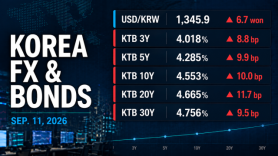
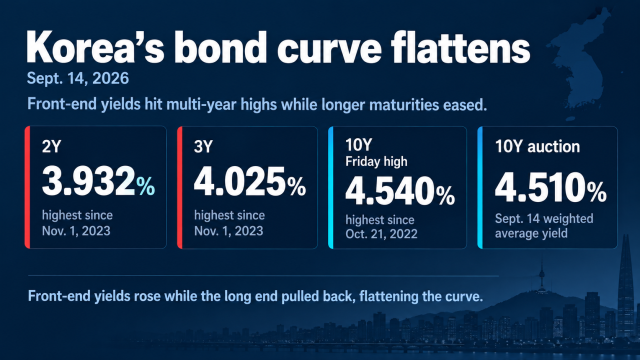
The two-year Korean government bond yield ended at 3.932 percent and the three-year at 4.025 percent, their highest levels since Nov. 1, 2023.
Longer maturities pulled back from Friday's highs. The 10-year yield had climbed to 4.540 percent Friday, its highest since Oct. 21, 2022, during the domestic bond-market turmoil triggered by the Legoland crisis.
The divergence flattened the curve as the front end, which is more sensitive to expectations for the Bank of Korea's base rate, caught up with longer maturities that had already repriced higher on inflation, oil and fiscal risks.
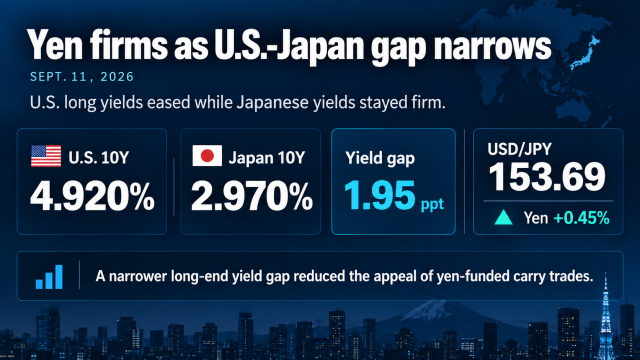
The two-year Treasury yield rose 4.4 basis points Friday to 4.594 percent, while the 10-year yield fell 2.4 basis points to 4.92 percent after briefly touching 4.98 percent following the latest U.S. inflation data.
The move suggests investors are pricing more near-term Federal Reserve tightening while also buying longer-dated bonds on expectations that higher rates will eventually weaken demand and inflation.
Markets now price roughly an 86 percent chance of a quarter-point Fed increase this week from the current 3.50 percent to 3.75 percent range.
U.S. consumer prices rose 0.4 percent in August from the previous month and 3.4 percent from a year earlier. Core prices gained 0.3 percent on the month, slightly above expectations.
Goldman Sachs shifted Monday to forecasting a 25-basis-point increase, while J.P. Morgan expects another hike in December.
The policy move itself is becoming less important to markets than the path beyond September.
Meritz Securities analyst Yoon Yeo-sam said Monday that a September hike had become the more realistic outcome, although he still believed the Fed would ideally avoid another increase.
Attention should increasingly turn to whether September marks the end of the tightening cycle or whether another increase follows in December, he said.
Mirae Asset Securities analyst Min Ji-hee had already forecast a quarter-point increase in a Sept. 10 preview and expects the Fed's rate projections for this year and next to move higher.
The flattening in U.S. yields does not mean growth concerns alone are driving longer maturities lower.
Oil briefly retreated around the inflation release, easing some near-term price pressure, before Brent crude returned above $100 a barrel as Middle East supply risks intensified.
That leaves the Fed confronting sticky inflation while monetary conditions continue to tighten.
BOJ adds pressure through the yen
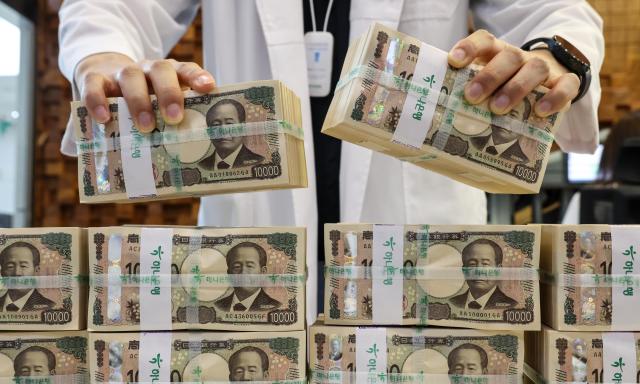
The BOJ is widely expected to raise its policy rate from 1 percent to 1.25 percent this week. All but two of 68 economists in a recent Reuters poll expect a hike, while 24 of 66 respondents see another increase to 1.50 percent as early as October or December.
The immediate move is therefore largely priced.
Markets are more focused on how quickly further increases follow.
Japan's producer prices rose 7.6 percent from a year earlier in August, while yen-based import prices jumped 24.8 percent.
Yoon expects the BOJ to raise rates to 1.25 percent this week and sees the tightening pace potentially accelerating toward one quarter-point increase every three to four months.
He sees a terminal rate of 1.75 percent as increasingly plausible rather than 1.50 percent.
The yen has strengthened sharply this month as markets priced faster BOJ tightening and investors reduced yen-funded carry positions.
Higher Japanese rates make borrowing in yen less attractive and can force leveraged investors to unwind positions in higher-yielding assets elsewhere.
Korea caught between Fed, BOJ and oil
South Korea sits between the two tightening channels.
Higher Fed rates lift global dollar funding costs and U.S. Treasury yields, putting upward pressure on Korean bond yields and potentially supporting the dollar against the won.
BOJ tightening works through the yen and regional capital flows by reducing the attraction of yen-funded carry trades and raising the risk of abrupt position unwinds.
Oil adds a third pressure point.
South Korea's heavy dependence on imported energy means a sustained rise in crude prices can lift domestic inflation even without further weakness in the won.
The Bank of Korea has already raised its Base Rate twice in succession from 2.50 percent to 3.00 percent and has said the timing and pace of further increases will depend on inflation, growth and financial stability.
Domestic bond yields have repriced accordingly.
Monday's 2.8 trillion won ($2.1 billion) 10-year government bond auction cleared at a weighted average yield of 4.510 percent, below Friday's 4.540 percent close.
The front end, however, continued to move higher.
Yoon expects the BOK's key rate eventually to reach 3.50 percent but said continued U.S. tightening and elevated oil prices could force markets to consider a terminal rate as high as 3.75 percent.
A parallel rise across maturities would point to a broad inflation or term-premium shock. A flattening curve instead suggests markets are assigning more weight to additional tightening in the near term while also considering the eventual growth cost.
AJP Takeaways
- South Korea's yield curve flattened further as two- and three-year government bond yields climbed to multi-year highs while longer maturities retreated.
- The move reflects growing expectations that the BOK may need to keep rates higher for longer as the Fed tightens further and oil stays elevated.
- The BOJ poses a separate risk through the yen, with faster Japanese tightening potentially accelerating carry-trade unwinds and reshaping regional capital flows.
- Markets are increasingly focused less on this week's expected quarter-point moves than on how far the Fed, BOJ and BOK tightening cycles still have to run.

Copyright ⓒ Aju Press All rights reserved.