SEOUL, September 21 (AJP) - The AI chip boom has made unexpected winners, and China is one of them — despite all the U.S. efforts and sanctions to cap China's rise in the chip sector.
ChangXin Memory Technologies, or CXMT, on Sunday announced mass production of its fifth-generation DRAM manufacturing platform, known as G5, along with two new 24-gigabit LPDDR5X products based on the process.
The advance pushes China's top memory chipmaker further into the heavily guarded realm of advanced DRAM technology despite U.S. restrictions on China's access to cutting-edge semiconductor manufacturing equipment.
But what is increasingly turning heads in the industry is not any single breakthrough. It is the speed of China's ascent.
"What is frightening about CXMT is the speed — it is moving extremely fast," said Lee Jong-hwan, a professor of system semiconductor engineering at Sangmyung University.
CXMT shares were up about 2.4 percent at 56.88 yuan in late Monday trade on Shanghai's STAR Market.
Investors in Seoul showed little immediate alarm. Samsung Electronics was 4.41 percent higher, while SK hynix ended the regular session 0.5 percent up.
CXMT has moved rapidly from building scale in conventional DRAM into more advanced mobile memory, while steadily increasing its share of the global market. It is also laying the groundwork for the next and far more lucrative frontier: high-bandwidth memory, or HBM, the critical memory used in artificial-intelligence accelerators.
CXMT said the new G5 platform reduced the active-area half-pitch of its memory arrays to 11.95 nanometers using quadruple patterning technology, allowing it to pack memory structures more densely.
The company said the number of dies produced from each wafer increased by at least 50 percent compared with its previous-generation process, based on an 8Gb-equivalent comparison.
Both LPDDR5X products are already in mass production and are aimed primarily at smartphones and other portable electronics, according to the company.
The announcement adds to a string of advances by CXMT as China seeks to reduce its dependence on foreign semiconductor technology.
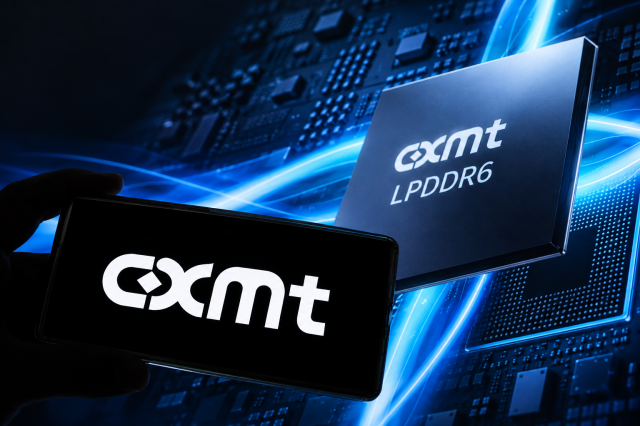
Earlier this month, CXMT announced mass production of LPDDR6, the next generation of low-power mobile DRAM, with the chip making its commercial debut in Xiaomi's 18 Fold smartphone. The product supports data rates of up to 12.8 gigabits per second and complies with the JEDEC LPDDR6 standard.
CXMT's technological ambitions are being accompanied by a rapid increase in market share at a time when frontier memory makers Samsung Electronics, SK hynix and Micron Technology are devoting more of their production and investment to the high-value chips powering AI accelerators and hyperscale data centers.
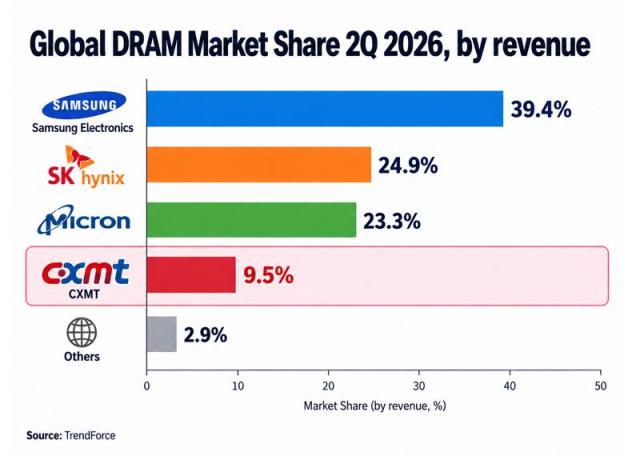
The Chinese chipmaker's share of global DRAM revenue rose to 9.5 percent in the second quarter from 7.6 percent in the previous three months, according to TrendForce.
CXMT has secured a formidable fourth place behind Samsung at 39.4 percent, SK hynix at 24.9 percent and U.S.-based Micron at 23.3 percent.
The gains are particularly notable as the world's three dominant memory makers increasingly direct capital and production toward HBM and advanced server DRAM.
The shift is opening room in parts of the conventional memory market just as CXMT is expanding capacity and improving its technology.
The immediate concern for Korean chipmakers is not that CXMT is about to displace them at the premium end of the market. It is how rapidly the Chinese company is accumulating the manufacturing experience, scale and market power needed to move further up the memory value chain.
Lee said Chinese memory makers are pursuing a deliberate strategy of securing a stronger position in lower-end products before advancing into higher-value chips.
"Chinese companies' strategy is to increase their market dominance with lower-end products while preparing for higher-end products," Lee said.
HBM is the natural destination because of its higher value and central role in AI computing, he said.
"Once they improve their capabilities in conventional DRAM, they can also build up their HBM capabilities more quickly," Lee said. "Chinese companies are gaining experience in conventional memory while preparing HBM and trying to narrow the gap."
Moving into HBM, however, requires much more than simply producing a more advanced DRAM die.
HBM stacks multiple DRAM dies vertically and requires sophisticated packaging and interconnection technologies to maintain high performance, power efficiency and reliability. Those requirements create another major technological hurdle for newcomers.
That also makes it difficult to determine how closely CXMT's latest G5 process actually matches those of Samsung and SK hynix based solely on measurements such as half-pitch.
CXMT described G5 as having process capabilities that rival the industry's most advanced mass-production nodes. But the assessment comes from the company itself, and developing a process does not necessarily mean it can be manufactured economically at the yields and volumes required by major customers.
Lee said yield — the proportion of usable chips produced from a wafer — remains one of the most important measures of a chipmaker's actual manufacturing capability.
"More than anything, it is yield," Lee said. "Development itself is something most companies can do to some extent. But achieving a good yield can take another one or two years."
Higher yields reduce manufacturing costs and allow chipmakers to deliver the volumes customers require, he said.
"That, in effect, is the technology," Lee said. "For semiconductors, mass-production capability and yield are extremely important."
CXMT therefore still has considerable ground to cover before it can challenge the Korean leaders in advanced HBM.
But its progress is becoming increasingly difficult to dismiss.
The Chinese company has continued advancing despite U.S. restrictions imposed since 2022 on China's access to some advanced semiconductor manufacturing equipment. CXMT said G5 was developed using computer simulations and joint work with Chinese equipment makers on critical production steps.
Chinese chipmakers also have strong incentives to prevent the technology gap from widening as HBM becomes increasingly important to AI computing, Lee said.
For Samsung and SK hynix, that means their current lead offers little room for complacency.
The immediate competitive pressure from CXMT remains concentrated in conventional and mobile DRAM rather than the most advanced HBM products.
But every step up the conventional memory ladder gives the Chinese company more manufacturing experience, scale and know-how that could eventually be applied further up the market.
CXMT's progression from conventional DRAM through LPDDR5X and LPDDR6, combined with its rising market share and latest G5 manufacturing advance, is therefore changing the question facing the established memory leaders.
It is becoming less about whether China's memory industry can climb the technology ladder than how quickly it can reach the next rung.
AJP Takeaways
- China's CXMT is rapidly advancing up the DRAM technology ladder, launching its G5 process and LPDDR6 as its global market share rises.
- CXMT's global DRAM revenue share climbed to 9.5 percent in the second quarter, securing fourth place behind Samsung Electronics, SK hynix and Micron.
- Korean chipmakers retain a significant lead in advanced HBM, but CXMT's growing scale and manufacturing expertise in conventional DRAM could help it narrow the gap over time.

Copyright ⓒ Aju Press All rights reserved.