

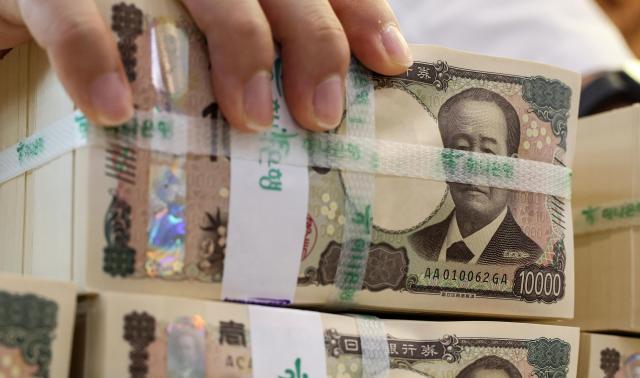
SEOUL, August 03 (AJP) -The United States and Japan vowed Monday to continue supporting the yen after admitting to a rare joint intervention last week to stabilize the currency of the world's largest foreign holder of U.S. Treasuries, which also resulted in lifting both the South Korean won and U.S. government bonds.
The admission explained last week's abrupt reversal in the yen, which in turn helped lift the South Korean won as investors unwound long-dollar positions across Asia.
Since the July 31 intervention, the yen has strengthened from nearly ¥164 per dollar at its weakest point to around ¥160.2 on Monday, while the Korean won appreciated to 1,424 per dollar from 1,549.4 at the end of June.
Japan’s Ministry of Finance said the two governments conducted coordinated yen-buying intervention on July 31 and remained prepared to act again if excessive volatility returned.
The operation was carried out in accordance with a joint statement issued by the US and Japanese finance ministers in September last year, Japanese Finance Minister Satsuki Katayama said.
Katayama said the intervention was aimed at countering recent excessive volatility and disorderly movements in the yen and that Tokyo would maintain close communication with Washington.
US Treasury Secretary Scott Bessent confirmed the action in a statement Sunday, saying Washington supported Japan’s efforts to correct what he described as a substantial undervaluation of the yen.
Bessent said the July 31 intervention had addressed disorderly movements in the Japanese currency and that the Treasury was closely coordinating with Japan’s Finance Ministry and the Bank of Japan.
“We will not hesitate to participate in further joint intervention,” he said.
US President Donald Trump also acknowledged Washington’s participation, telling reporters that Japan had needed assistance because of the yen’s decline.
Trump said US participation reflected the close relationship between the two countries and would also benefit the global economy.
The operation marked the first jointly acknowledged foreign-exchange intervention by the United States and Japan since March 2011.
The 2011 intervention was conducted with other major economies to weaken the yen after the earthquake and tsunami in eastern Japan, while the latest operation sought to support the currency through yen purchases.
It was also the first coordinated US action to strengthen the yen since 1998.
The yen had weakened to almost 164 per dollar late last month, its lowest level in about four decades, before the two governments entered the market.
The confirmation of the joint action pushed the dollar lower against the yen during Asian trading Monday.
The South Korean currency also gained as the announcement reinforced expectations that US and Japanese authorities would resist renewed, disorderly yen depreciation.
The won and yen are often sensitive to similar movements in the dollar and regional currency trading, although the US transaction did not involve a direct sale of dollars.
The bond-market implications of the intervention have also drawn attention because Japan may need to raise dollars to finance repeated yen purchases.
Japan is the largest foreign holder of US government debt, meaning outright sales of its Treasury holdings could add pressure to US long-term borrowing costs. As of May, it held $1.143 trillion worth U.S. treasuries.
Bessent highlighted the Federal Reserve’s Foreign and International Monetary Authorities Repo Facility, or FIMA Repo Facility, as an important mechanism and called for its capacity to be expanded in the coming months.
The facility allows approved foreign central banks and monetary authorities to obtain dollars temporarily by placing US Treasury securities with the Federal Reserve rather than selling them in the open market.
The Fed has said the programme can help prevent disruptions in the Treasury market by reducing the need for foreign monetary authorities to sell their holdings outright when they require dollar liquidity.
Japan said it planned to use the facility to secure sufficient dollar funding without selling its Treasury holdings.
US Treasury yields declined during Asian trading after the joint intervention was formally confirmed.
The benchmark 10-year Treasury yield stood at 4.696 percent as of 10:10 a.m. in Seoul, down 4.9 basis points from the previous close.
The 30-year yield fell 3.5 basis points to 5.240 percent over the same period.

Copyright ⓒ Aju Press All rights reserved.
