

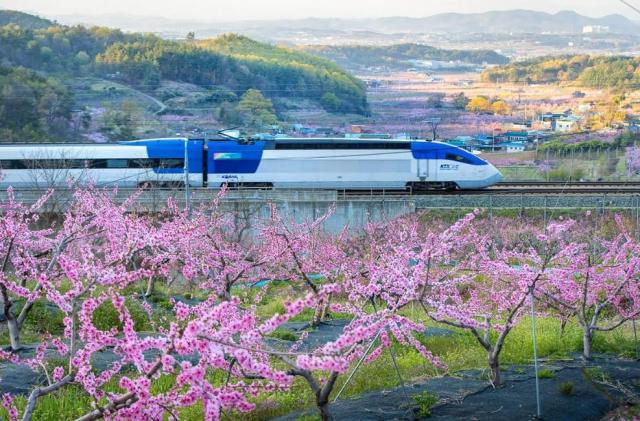
As demand for rail travel among foreign visitors rapidly increases, concerns are growing over the fragmented transportation system connecting Incheon Airport to Busan and Gyeongju. The lack of a direct connection from the airport to the high-speed rail service in the southern region has led to repeated bottlenecks during transfers at Seoul Station, including luggage handling and seat reservations.
According to the railway industry on June 15, foreign travelers typically take the airport train to Seoul Station before transferring to the KTX. While there is a connection between the airport and the rail system, the actual travel process is far from a seamless journey that integrates air travel, airport rail, and high-speed trains.
The most significant issue is the discontinuation of KTX service directly from Incheon Airport. The Incheon Airport KTX, which began operations in June 2014 with 22 daily trains, was officially discontinued in September 2018 due to low passenger numbers and operational inefficiencies. Since then, direct high-speed rail routes from Incheon Airport to major regional cities like Busan, Gyeongju, and Daegu have been eliminated.
The KTX service planned to open by the end of this year will not provide a direct alternative to Incheon Airport. This KTX service will start from Songdo Station on the Suin-Bundang Line, connecting the southern Incheon area to the national KTX network, but it does not allow incoming passengers at Incheon Airport to board the KTX directly to regional destinations. The city of Incheon is pursuing an extension of the airport rail through a second airport railway, but it has not yet been confirmed whether this will be included in the national railway network construction plan.
Reviving the Incheon Airport KTX is not a straightforward task. The previous service shared tracks with the airport rail, which raised concerns about operational efficiency for both express and regular trains. To reconnect Incheon Airport with the high-speed rail network, considerations must include track capacity, train frequency, stop locations, and existing demand for the airport rail.
Under the current system, travelers must account for delays in flight arrivals, immigration processing, and baggage claim times. If a flight arrives late, passengers risk missing their reserved KTX. Conversely, if they allow for extra time, they may face longer waits at Seoul Station. For first-time foreign travelers, the variables involved in getting from the airport to the train station remain a personal burden.
Transfers at Seoul Station are also seen as a bottleneck. This complex station serves as a hub for the airport rail, subway, conventional rail, and high-speed trains. During peak travel times, foreign travelers with large suitcases must navigate multiple levels and platforms simultaneously. Although the rail network is connected, users often find that the experience is far from a seamless journey.
The reservation and payment systems also operate separately. Airline tickets, airport rail tickets, and KTX tickets must be booked and paid for on different platforms. While Korail is working to improve convenience through multilingual app enhancements, expanded acceptance of foreign credit cards, and dedicated transportation passes for foreigners, an integrated booking system that automatically connects KTX schedules to flight delays and immigration times is still lacking.
Baggage handling remains another challenge. The urban airport terminal at Seoul Station assists departing passengers with check-in and baggage drop-off, but it does not alleviate the burden of luggage transfer for foreign travelers arriving at Incheon Airport and heading to Busan or Gyeongju. As the demand for rail travel among foreigners increases, managing elevators, escalators, baggage movement, and crowd control at transfer stations will become increasingly important.
A guesthouse operator near Busan Station noted, "Foreign guests who arrive via KTX from Incheon often mention how difficult it is to manage their luggage." They added, "First-time visitors sometimes struggle with the transfer process at Seoul Station itself."
A Korail official stated, "We are continuously working to improve services for foreign users," but acknowledged that creating an integrated booking system encompassing airlines, airports, and railways is a complex challenge that a single organization cannot tackle alone.
Experts emphasize the need for a long-term roadmap that encompasses both airport and rail policies, going beyond short-term convenience improvements. They argue that plans for a direct high-speed rail network from Incheon Airport, the second airport railway, the KTX extension from Incheon, transfer routes at Seoul Station, baggage handling systems, and integrated booking for air and rail travel should all be considered together.
Professor Kang Kyung-woo of Hanyang University’s Department of Transportation and Logistics Engineering stated, "We need to explore ways to utilize Gimhae Airport as a second airport, and if we can reduce travel time between Seoul and Busan to around 1 hour and 20 minutes through KTX upgrades, it would significantly enhance the flow of foreign visitors traveling from Incheon Airport to Busan via Seoul."
* This article has been translated by AI.
Copyright ⓒ Aju Press All rights reserved.