

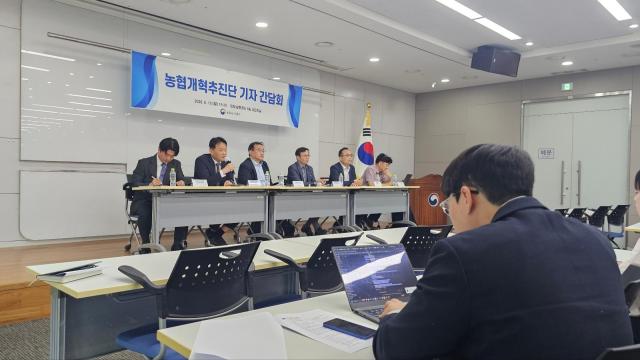
Press conference of the Agricultural Cooperative Reform Promotion Team [Photo=Ministry of Agriculture, Food and Rural Affairs]
The government is addressing concerns surrounding the reform of agricultural cooperatives. Officials stated that the costs associated with establishing an independent Agricultural Cooperative Audit Committee would not be excessive, and that access to accounting records would be regulated to prevent misuse of information.
On June 15, the Agricultural Cooperative Reform Promotion Team held a press briefing at the Government Sejong Center, where they shared updates on the legislative progress of the agricultural cooperative reform. The team previously announced a reform plan aimed at enhancing transparency and addressing gaps in government oversight of agricultural cooperatives. However, concerns have been raised within the agricultural sector regarding potential administrative costs and infringements on the autonomy of cooperatives, prompting the government to clarify these issues.
During the briefing, the team revealed that the annual operating cost for the independent audit committee is expected to be around 50 billion won. Won Seung-yeon, a professor of business administration at Myongji University and head of the reform team, stated, "We plan to design the independent corporation with approximately 250 personnel, which would allow it to operate within the current expenditure levels of around 50 billion won for the existing audit committees."
The team also refuted claims from agricultural cooperatives that establishing the new corporation would incur costs of around 150 billion won. Won noted, "The cooperatives' calculations assume a staffing level of 450 to 500, but the basis for this figure is questionable." He emphasized that the current agricultural cooperative law has removed the central council's audit authority, which falls under legislative policy.
Concerns about equity arising from enhanced information disclosure for cooperatives and the central council are viewed as unfounded by the government. The Ministry of Agriculture, Food and Rural Affairs is considering reducing the number of individuals required to access accounting records from the current 100 to below 20. However, some in the agricultural sector worry that this could lead to an influx of information requests, which they believe is overly simplified compared to corporate standards.
In response, Professor Won explained, "Under commercial law, the rights of minority shareholders indicate that the current access to accounting records for cooperatives and the central council is actually more stringent. If we apply the condition of holding shares for more than six months to the average number of members, it would be around one or two individuals. We can prevent unnecessary requests by establishing 'exceptions for disclosure.'"
The reform team also assessed the estimated costs associated with direct elections for all cooperative members as excessive. While Kang Ho-dong, the chairman of the National Agricultural Cooperative Federation, has expressed support for direct elections, there remains a disagreement over who should bear the election costs.
A team official stated, "Considering the estimated cost of 6,800 won per person for presidential election outsourcing, we anticipate that the expenses will be between 20.8 billion and 22.8 billion won, rather than the 40.6 billion claimed by the cooperatives. It is reasonable for the cooperatives to bear these costs themselves rather than relying on government subsidies for internal representative elections."
The reform team also outlined plans for a second reform initiative aimed at revitalizing economic activities. This second phase will focus on enhancing the benefits for cooperative members and improving institutional frameworks, as well as strengthening the roles of urban cooperatives. The team expects to finalize and announce the second reform plan in July or August, following the completion of the legislative process for the first reform plan.
On June 15, the Agricultural Cooperative Reform Promotion Team held a press briefing at the Government Sejong Center, where they shared updates on the legislative progress of the agricultural cooperative reform. The team previously announced a reform plan aimed at enhancing transparency and addressing gaps in government oversight of agricultural cooperatives. However, concerns have been raised within the agricultural sector regarding potential administrative costs and infringements on the autonomy of cooperatives, prompting the government to clarify these issues.
During the briefing, the team revealed that the annual operating cost for the independent audit committee is expected to be around 50 billion won. Won Seung-yeon, a professor of business administration at Myongji University and head of the reform team, stated, "We plan to design the independent corporation with approximately 250 personnel, which would allow it to operate within the current expenditure levels of around 50 billion won for the existing audit committees."
The team also refuted claims from agricultural cooperatives that establishing the new corporation would incur costs of around 150 billion won. Won noted, "The cooperatives' calculations assume a staffing level of 450 to 500, but the basis for this figure is questionable." He emphasized that the current agricultural cooperative law has removed the central council's audit authority, which falls under legislative policy.
Concerns about equity arising from enhanced information disclosure for cooperatives and the central council are viewed as unfounded by the government. The Ministry of Agriculture, Food and Rural Affairs is considering reducing the number of individuals required to access accounting records from the current 100 to below 20. However, some in the agricultural sector worry that this could lead to an influx of information requests, which they believe is overly simplified compared to corporate standards.
In response, Professor Won explained, "Under commercial law, the rights of minority shareholders indicate that the current access to accounting records for cooperatives and the central council is actually more stringent. If we apply the condition of holding shares for more than six months to the average number of members, it would be around one or two individuals. We can prevent unnecessary requests by establishing 'exceptions for disclosure.'"
The reform team also assessed the estimated costs associated with direct elections for all cooperative members as excessive. While Kang Ho-dong, the chairman of the National Agricultural Cooperative Federation, has expressed support for direct elections, there remains a disagreement over who should bear the election costs.
A team official stated, "Considering the estimated cost of 6,800 won per person for presidential election outsourcing, we anticipate that the expenses will be between 20.8 billion and 22.8 billion won, rather than the 40.6 billion claimed by the cooperatives. It is reasonable for the cooperatives to bear these costs themselves rather than relying on government subsidies for internal representative elections."
The reform team also outlined plans for a second reform initiative aimed at revitalizing economic activities. This second phase will focus on enhancing the benefits for cooperative members and improving institutional frameworks, as well as strengthening the roles of urban cooperatives. The team expects to finalize and announce the second reform plan in July or August, following the completion of the legislative process for the first reform plan.
* This article has been translated by AI.
Copyright ⓒ Aju Press All rights reserved.