
"We will strengthen our role as the last bastion of national healthcare and establish future healthcare standards based on connected healthcare and artificial intelligence (AI)."
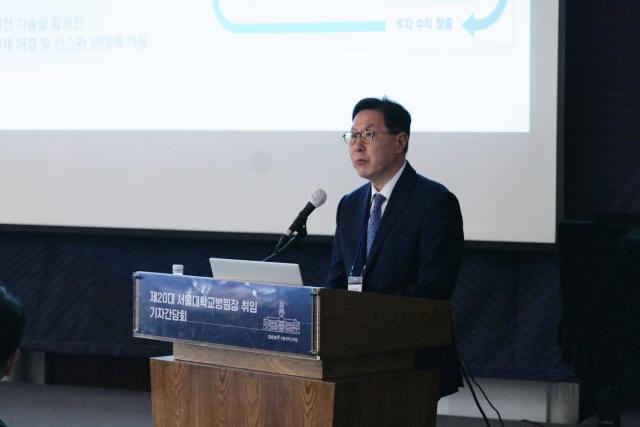
Seoul National University Hospital is embarking on a significant transformation focused on responding to the essential healthcare crisis and digital transition. Baek Nam-jong, the newly appointed head of the hospital, made this statement during a press conference held on June 15 at the Press Center in Jung-gu, Seoul. He emphasized the hospital's commitment to fulfilling its role as a think tank for national healthcare standards and policies.
During the press conference, Baek unveiled a mid-to-long-term strategy centered on two pillars: the completion of essential healthcare and the establishment of intelligent connected healthcare. This plan aims to address structural crises such as the collapse of essential healthcare, regional disparities, and the challenges posed by an aging society by enhancing the public healthcare control tower's role.
A key component of this strategy is the 'One-Hospital' system. The plan involves creating a nationwide collaborative governance structure that connects regional and public healthcare, concentrating treatment capabilities for severe and rare diseases around Seoul National University Hospital.
The hospital will also accelerate its digital transformation. It plans to introduce a 'Digital Hospital at Home' model that continues care and treatment after discharge, alongside the development of its own medical AI platform, 'SNUH.AI,' to enhance efficiency across clinical and operational processes.
From a research and industrial perspective, the hospital aims to establish an integrated ecosystem connecting Seoul National University (basic research), Seoul National University Hospital (clinical), Bundang Hospital (digital healthcare), and Baekgok Hospital (smart rehabilitation). The goal is to position itself as a global hub for the expansion of 'K-Medical' through the training of physician-scientists (MD-PhD) and the commercialization of technology.
Significant infrastructure investments will accompany these initiatives. Notable projects include the establishment of an infectious disease specialty hospital at Bundang Seoul National University Hospital, a heavy ion therapy center in Gijang (scheduled for 2027), and Baekgok Seoul National University Hospital (scheduled for 2029).
Specifically, Bundang Seoul National University Hospital plans to significantly expand its clinical and research infrastructure by constructing a large-scale infectious disease specialty hospital in the metropolitan area and enhancing the Ji Seok-young Biomedical Research Institute to create a clinical training center. Boramae Hospital in Seoul will establish a 'Safe Respiratory Care Center' dedicated to the final treatment of severely vulnerable populations, while the Gangnam Center will evolve into an AI-based preventive medicine hub covering everything from disease prediction to personalized prevention.
Additionally, Seoul National University Children's Hospital is undertaking a comprehensive remodeling project to increase the proportion of rooms with four beds or fewer to 93%, creating a more comfortable healing environment. Baek stated, "We aim to expand in a way that is fitting for a children's hospital in the long term."
To address the issue of emergency patients experiencing delays in treatment, often referred to as 'emergency room circling,' Baek expressed his intention to leverage the leadership of national university hospitals. However, he noted, "This is not an issue that can be solved by the strength of a single hospital," and emphasized the importance of building a trust-based network that enables information exchange and collaborative care among hospitals, regardless of their location. He added, "We plan to secure leadership in education and research, lead the transition to medical AI, and actively utilize the research capabilities of Bundang Seoul National University Hospital."
Baek was appointed as the head of Seoul National University Hospital on May 13, with a term set to last until May 12, 2029. A graduate of Seoul National University College of Medicine, he previously served as a professor in the Department of Rehabilitation Medicine at Bundang Seoul National University Hospital, where he held various roles including director of the Clinical Cooperation Center, head of the Public Relations Office, and head of the Planning and Coordination Office. He was the president of Bundang Seoul National University Hospital from 2021 to 2023.
* This article has been translated by AI.
Copyright ⓒ Aju Press All rights reserved.