

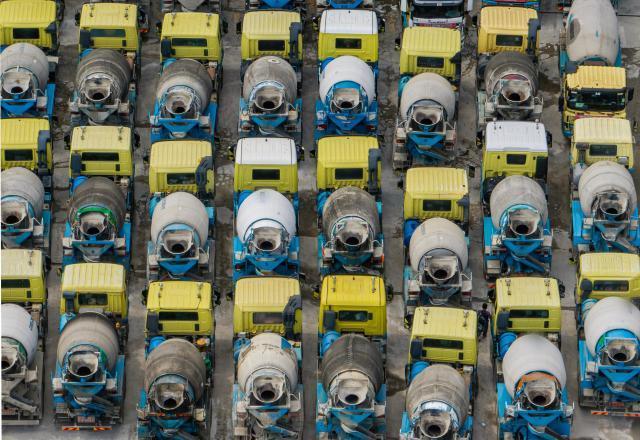
The strike by concrete transport unions in the Seoul metropolitan area ended after eight days, but the construction supply chain was already pushed to its limits. The combined storage capacity of concrete plants and cement distribution centers could only withstand a transportation halt for about six days. As the strike extended into its seventh day, the cement industry began considering production cuts.
According to the cement industry on June 16, concrete plants in the metropolitan area had about two days' worth of cement stock, while rail distribution centers in areas like Suwon and Uiwang had about three to four days' supply. This means that if concrete transportation stops, the entire supply chain can barely last a week.
As the strike surpassed seven days, concerns about distribution center saturation became a reality. Industry estimates indicate that cement shipments decreased by about 40% during the strike. A representative from the Korea Cement Association stated, "The silos at concrete plants in the metropolitan area were already full. We tried to maximize loading at distribution centers nationwide, but even that reached its limit." He added, "It is rare for a strike to last more than a week, which is why some companies considered production cuts in anticipation of a prolonged situation."
The impact on construction sites also highlighted the vulnerabilities in the supply chain. According to the Korea Construction Association, as of June 12, the fifth day of the strike, concrete supply was cut off at 105 construction sites of 22 major construction companies in the metropolitan area, delaying the pouring of about 100,000 cubic meters of concrete. This disruption affected key national industrial sites, including Samsung Electronics' Pyeongtaek campus and SK Hynix's semiconductor cluster in Yongin, raising concerns that the concrete dispute has escalated into a broader industrial supply chain risk.
A significant issue is the lack of viable alternative measures during strikes. Lee Sang-il, executive director of the Korea Ready-Mixed Concrete Association, noted, "We attempted to continue shipments using non-union vehicles, but there aren't enough available in the metropolitan area, making it insufficient." This indicates that simply deploying non-union vehicles is not enough to prevent supply disruptions when transportation vehicle availability is limited.
In light of this situation, calls for discussions on regulatory improvements have intensified within the construction industry. Key proposals include easing regulations on the total number of mixer trucks, utilizing on-site batching plants, and establishing emergency supply chain manuals. The total mixer truck regulation, which has been in place for 12 years, is identified as a structural factor that diminishes the supply chain's responsiveness during strikes.
Without supplementary measures such as on-site production, construction sites remain vulnerable to disruptions in concrete transportation. Industry experts suggest that for major public projects or sites with high risks of work stoppages, flexible consideration should be given to installing on-site batching plants, and criteria for prioritizing supply to key sites should be established from the onset of a strike.
The Korea Construction Management Association has also warned that the suspension of concrete supply could lead to a cascade of issues beyond mere schedule delays, including quality degradation, increased construction costs, and financial difficulties for subcontractors, urging regulatory improvements such as easing supply control measures.
Importantly, the recent agreement does not signify the end of the conflict. The labor and management sides agreed to increase transportation costs by 4,200 won per trip starting in July, with a further increase to 5,200 won over the following four months. Given that the contract period extends only until February 2027, there remains a possibility of renewed conflict during the renegotiation process in March.
The cost structure exacerbates the potential for future disputes. The price of ready-mixed concrete in the metropolitan area has risen by 77% compared to 2009, reaching 99,600 won per cubic meter, while transportation costs have surged by 150% during the same period. With a decline in construction activity leading to reduced volumes, the burden of transportation costs continues to accumulate, narrowing the room for management to accept further increases.
Lee stated, "I understand that the Ministry of Land, Infrastructure and Transport is considering measures such as installing on-site batching plants and easing mixer truck regulations," but he cautioned that institutional measures take time to yield results, emphasizing the need for short-term response strategies as well.
* This article has been translated by AI.
Copyright ⓒ Aju Press All rights reserved.