

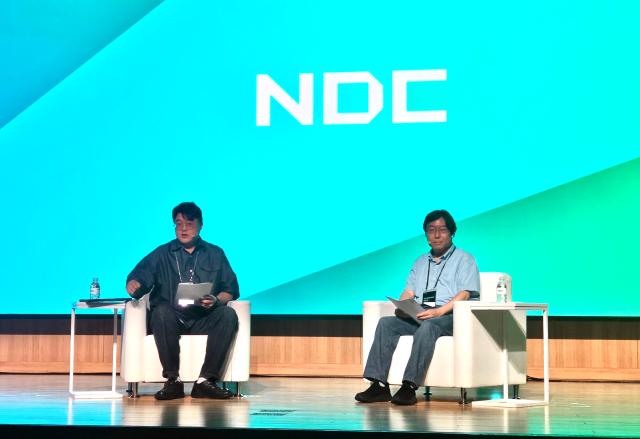
Park Yong-hyun, CEO of Nexon Games, described the company's approach to simultaneous project development as a "structure chosen for survival." He noted that the gaming market is increasingly divided between large-scale games with high production costs and those targeting specific user preferences, making it difficult for mid-tier games to thrive.
During a session at the Nexon Developer Conference 2026 held at the Gyeonggi Creative Economy Innovation Center in Seongnam, Park discussed Nexon Games' parallel development strategy with Lee Kyung-hyuk, editor of Game Generation.
The discussion began with Park reflecting on his gaming experiences. When asked about his most memorable game, he cited the MMORPG "EverQuest," recalling how, despite his frustrations during long quests, the joy of obtaining items made it worthwhile. He emphasized the importance of understanding what experiences bring satisfaction to users rather than merely replicating specific content.
Park observed that user preferences in the current gaming market are rapidly diversifying. He stated, "Today, games are either massive titles that offer everything or those that focus sharply on a specific aspect that users desire. Games in between are struggling."
He explained that while large games carry significant development costs, niche games may have a higher risk in terms of operational sustainability.
Nexon Games' simultaneous development structure has emerged in response to these market conditions. According to Park, the company is currently developing about five live games and four new projects concurrently. He remarked, "Companies that have not achieved the success of games lasting 10 or 20 years are struggling to survive for over a decade, leading to our current situation."
Park attributed this phenomenon to the unique characteristics of the Korean gaming industry, which has grown primarily around online games. Unlike packaged games, where development teams can move on to new projects after release, online games require ongoing development resources for live services. This structure can lead to excessively long intervals between new game releases.
Regarding Nexon Games' genre expansion, Park described it as having "one foot in role-playing games (RPGs) and the other exploring other genres." While the company appears to be diversifying into various genres like shooting and subculture games, he noted that there are underlying similarities in growth structures and core systems based on RPGs.
He identified the accumulation of experience as a key competitive advantage of simultaneous development, allowing lessons learned from previous projects to inform future ones.
Looking ahead, Park highlighted the need for Nexon Games to enhance its long-term live service capabilities. He stated, "I believe we have reached a point where our games receive decent evaluations from users upon launch, but we still fall short in maintaining positive feedback over the long term." He added, "Our next challenge is to ensure that the games we are currently developing penetrate the market effectively and foster long-term engagement with users rather than achieving only short-term results."
* This article has been translated by AI.
Copyright ⓒ Aju Press All rights reserved.