

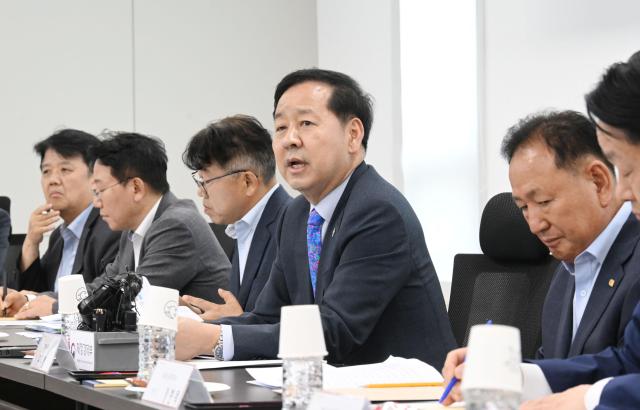
During his visit to Haenam Solar City, the first stop of the "5 Regions 3 Specialties Growth Engine Pick and Back" site tour, Koo held a press conference to discuss these points.
Koo explained his choice of Haenam as the first location, noting that it is an area with high solar energy efficiency, making it suitable for fostering industries based on renewable energy. He remarked, "Solar power generation must focus on producing the cheapest electricity by evaluating costs and benefits for the most efficient methods. If businesses are supplied with affordable and stable electricity, investment and establishment will naturally follow."
He added, "The 5 Regions 3 Specialties policy consists of two pillars: the economy and daily life. Ultimately, a thriving economy is essential for creating momentum for regional development." He highlighted the significance of discussing growth strategies with local research institutions, chambers of commerce, and businesses.
The press conference also addressed tax support measures for balanced regional development. Koo stated, "Support is needed for areas that are far from Seoul and relatively disadvantaged," and mentioned that the government is considering differentiated support that directly benefits workers rather than focusing solely on businesses. He also noted that the green transition is directly linked to future economic prospects, advocating for a swift shift to a low-carbon economy through measures such as issuing green bonds.
When asked about the possibility of a second supplementary budget in response to the U.S.-Iran conflict and high exchange rates and oil prices, Koo emphasized the importance of efficiently executing the first supplementary budget. He stated, "At this point, it is more crucial to effectively utilize the existing budget and the first supplementary budget than to consider a second supplementary budget. We will focus on economic recovery and growth by maximizing the use of this year's budget and supplementary budget."
Koo expressed optimism regarding signs of stability in the Middle East, noting that the U.S. and Iran have signed a memorandum of understanding (MOU) and are expected to proceed with additional signing procedures. He mentioned that the exchange rate is stabilizing around 1,510 won, and foreign investors are beginning to return to the domestic market.
He also pointed out that international oil prices have fallen to the low $80 per barrel range, indicating positive signals, but cautioned that the situation in the Strait of Hormuz and the final agreement still need to be monitored.
Regarding the economic outlook post-conflict, Koo noted that exports remain strong, and the semiconductor industry is expected to continue performing well for the time being. He revealed that the government plans to increase investments in future industries, including artificial intelligence. He emphasized that South Korea has sufficient competitiveness not only in memory semiconductors but also in power semiconductors and sensor semiconductors. He stated, "As the shipbuilding, defense, and content industries currently drive growth, securing new growth items will ensure a bright future for the Korean economy."
On the use of excess tax revenue, Koo outlined the principles of prioritizing national growth and addressing polarization. He explained, "This year, we are seeing higher-than-expected tax revenue due to strong semiconductor exports and rising prices. However, if this trend continues into next year, it should be viewed as an expansion of the tax base rather than a temporary surplus."
He clarified the direction for utilizing excess tax revenue, stating, "First, it should be used for national development, and second, it should address polarization." He added, "We cannot only talk about national development. Support for vulnerable groups such as youth, small businesses, and self-employed individuals is also essential. I believe there is a social consensus on these two principles."
* This article has been translated by AI.
Copyright ⓒ Aju Press All rights reserved.