

Chinese state media criticized the Group of Seven (G7) summit on June 17, stating that the organization is "outdated" and lacks the capacity to respond to global challenges, instead highlighting its internal divisions. The report suggested that efforts to strengthen internal cohesion by countering China are unlikely to succeed.
The Global Times, a Chinese state-run English-language newspaper, quoted experts who said the G7 summit failed to showcase Western unity and instead revealed the differences between the United States and Europe. The newspaper noted that while the G7 once played a key role in addressing major international political and economic issues, its influence is waning, making it increasingly difficult to fulfill that role due to deepening internal contradictions.
Chui Hongjian, a professor at Beijing Foreign Studies University, told the Global Times that the G7's effectiveness has relied on the premise that cooperation among member states outweighs disagreements. However, he noted that this balance is now shifting. He added that European nations are trying to align with the U.S. position while seeking new common goals to maintain G7 unity amid growing internal conflicts.
Chui also pointed out that issues related to Russia and energy security have emerged as key topics at this year's summit. He mentioned that while some member countries have attempted to unite against China as a common adversary, they have yet to achieve significant results.
Li Haidong, a professor at the China Foreign Affairs University, remarked that attempts to strengthen internal cohesion through confrontation with China are unlikely to succeed. He emphasized that simply designating an external competitor will not lead to sustained unity if the G7 cannot resolve its own divisions and structural issues. He further stated that such an approach cannot reverse the decline of the G7 system itself.
Concerns were also raised about whether the G7 can exert the desired level of influence without the participation of China, the world's second-largest economy.
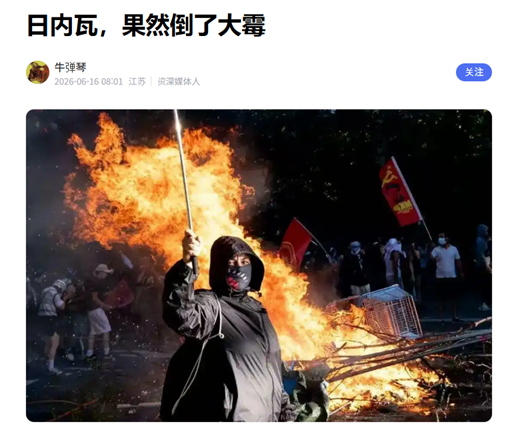
On June 16, Newtanqin, a social media account affiliated with the Chinese state news agency Xinhua, stated that many believe the G7 is outdated. It criticized the group for calling itself the seven major economies while excluding China, the largest economy, questioning its representativeness.
The G7 meeting, held from June 15 to 17 in Évian-les-Bains, France, addressed geopolitical crises such as the wars in Iran and Ukraine, as well as global economic issues, including China's trade imbalances and overproduction.
Earlier, on June 15, the Global Times referred to the G7 as a "hypocritical club of wealthy nations," criticizing its members for shifting the blame for economic slowdowns, rising debt, declining industrial competitiveness, social divisions, and aging populations onto China.
* This article has been translated by AI.
Copyright ⓒ Aju Press All rights reserved.