

Global investment flows driven by the artificial intelligence (AI) boom are rapidly expanding beyond leading semiconductor companies to encompass domestic materials, components, and equipment (known as 소부장), as well as power infrastructure and aerospace sectors. Smaller equipment stocks are experiencing stock price increases of several hundred percent.
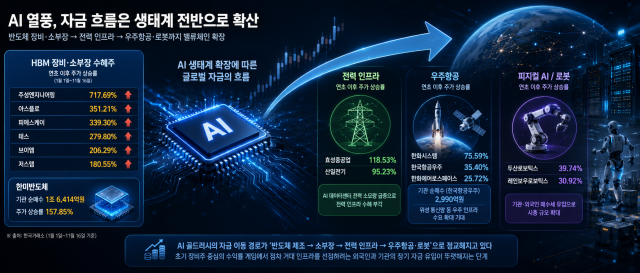
According to the Korea Exchange, an analysis of the stock price trends of key AI value chain companies listed on the domestic market from the beginning of the year until June 16 revealed that the most explosive growth occurred in the high-bandwidth memory (HBM) equipment and 소부장 sectors.
During this period, stocks such as JUSUNG Engineering surged by 717.69%, followed by Aspro (351.21%), PSK (339.30%), TES (279.80%), VM (206.29%), and Jostem (180.55%). This surge is attributed to a supply shortage of HBM from NVIDIA, which has increased the value of domestic post-processing and materials and components companies. Hanmi Semiconductor, a leading player in the 소부장 sector, also saw a 157.85% increase in stock price, supported by institutional investors who purchased a net 1.64 trillion won worth of shares.
Market interest is now shifting towards infrastructure and physical AI sectors. Due to a significant increase in power consumption by AI data centers, companies in the power infrastructure sector, such as Hyosung Heavy Industries (118.53%) and Sanil Electric (95.23%), have also recorded sharp rises.
Notably, funds are flowing into the aerospace sector, which is considered a hidden key player in next-generation AI infrastructure. Companies like Hanwha Systems (75.59%), Korea Aerospace Industries (35.40%), and Hanwha Aerospace (25.72%) may not have seen as dramatic stock price increases compared to the 소부장 sector, but they have each established market capitalizations in the trillion-won range.
In particular, Korea Aerospace Industries received net purchases of 299 billion won from institutional investors during this period, supporting its stock price. The anticipation that advancements in AI, including autonomous driving and robotics, will stimulate demand for satellite communication networks and other aerospace infrastructure is reflected in these trends.
Investor funds are also moving towards the physical AI and device sectors. Robotics-related stocks, such as Doosan Robotics (39.74%) and Rainbow Robotics (30.92%), are expanding their market capitalizations amid buying trends from institutions and foreign investors.
A securities industry official stated, "The flow of funds in the AI gold rush is becoming more sophisticated, moving from semiconductor manufacturing to materials and components, power infrastructure, aerospace, and robotics. We are now seeing a clear influx of long-term funds from foreign and institutional investors aiming to secure large-scale infrastructure, shifting away from the initial focus on equipment stocks."
* This article has been translated by AI.
Copyright ⓒ Aju Press All rights reserved.