

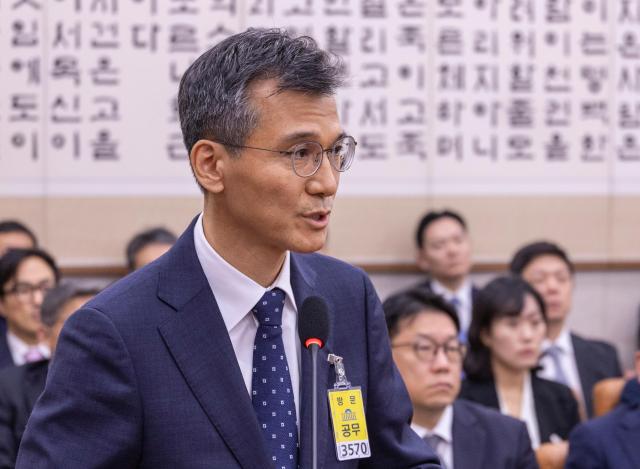
The Chief Inspector of the Supreme Prosecutors' Office has filed a constitutional appeal against a provision in the Prosecutor Office Law that does not guarantee his term, arguing it violates the principle of separation of powers outlined in the constitution.
On June 17, Kim Seong-dong announced in a statement that he has requested the Constitutional Court to review Article 7 of the supplementary provisions of the Prosecutor Office Law, which excludes "term-limited prosecutors" from succession to the new prosecutor's office. He is also expected to submit a request for a stay of the provision's effect alongside the constitutional appeal.
The contested provision specifies that existing prosecutors from the Supreme Prosecutors' Office will transition to the newly established prosecutor's office, but excludes those with fixed terms from this transition.
Currently, the only prosecutors guaranteed a term under the Prosecutor Office Law are the Prosecutor General and the Chief Inspector. However, since former Prosecutor General Shim Woo-jung retired in July of last year, the position has remained vacant for nearly a year.
As the new prosecutor's office is set to launch soon, there is little expectation that President Yoon Suk-yeol will appoint a new Prosecutor General, leading to interpretations that the provision targets only Chief Inspector Kim.
Like the Prosecutor General, the Chief Inspector's position is legally guaranteed for a term of two years. Kim was appointed in May 2022 and is assured of his position until May 18, 2027. However, with the establishment of the new prosecutor's office under the Prosecutor Office Law in October, he will be automatically dismissed before completing his term.
In response, Kim criticized the Prosecutor Office Law, stating, "It is a direct violation of the constitutional principle of separation of powers for the National Assembly to legislate the dismissal and retirement of specific public officials under the executive branch."
He further pointed out that excluding the Chief Inspector from succession without a rational basis contradicts the principle of equality and infringes on equality rights.
Kim also added that abruptly terminating a legally established term and retirement undermines the principle of trust protection and the prohibition of retroactive legislation. He argued that dismissing the Chief Inspector, despite no fundamental changes in the oversight structure with the new prosecutor's office, constitutes an infringement on the right to hold public office that exceeds the principle of proportionality.
Nevertheless, Kim concluded his statement by affirming his commitment to diligently carry out oversight duties throughout his designated term, regardless of the legal proceedings surrounding the constitutional appeal.
* This article has been translated by AI.
Copyright ⓒ Aju Press All rights reserved.