

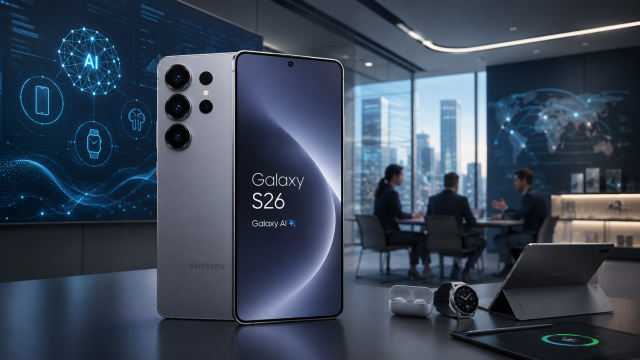
Sales of the Galaxy S26 have started strong, but the mood at Samsung Electronics' Mobile Experience (MX) division remains cautious. Despite defending sales volumes with premium products amid a slowdown in the global smartphone market, rising memory prices and component costs are putting pressure on profitability. Additionally, ongoing union issues have made securing momentum for a rebound in the second half of the year more critical than ever.
According to industry sources on June 17, Samsung's MX division is reassessing its smartphone strategy for the second half of the year based on the sales trends of the Galaxy S26 series. The Galaxy S26 has attracted market interest with its artificial intelligence (AI) features, camera performance, and premium design. In a time of weak overall smartphone replacement demand, flagship products have played a crucial role in maintaining sales.
However, strong sales have not directly translated into improved profitability. The demand for AI servers has driven up prices for DRAM and NAND memory, increasing the cost burden for smartphones. High-end smartphones incorporate many expensive components, including mobile DRAM, storage devices, application processors, displays, and camera modules. The pressure on costs is particularly pronounced for premium products due to their higher specifications.
Samsung is attempting to absorb some of the cost burden through price increases for the Galaxy S26 and an expansion of its premium lineup. However, raising prices indiscriminately in a period of consumer slowdown is challenging. Apple maintains strong loyalty in the premium market, while Chinese competitors are aggressively pricing high-spec products. Samsung faces the dual challenge of maintaining both sales volume and profitability.
Internal dynamics also pose a challenge. Ongoing union issues at Samsung Electronics require the MX division to balance organizational stability with performance outcomes. The smartphone business has a short product launch cycle, and market reactions are quickly reflected in sales results. A disrupted organizational atmosphere could hinder the speed of development, marketing, and supply chain responses.
The key battleground for the second half will be foldables and Galaxy AI. Samsung needs to reaffirm its leadership in the foldable market with new products in the Galaxy Z series. Although Samsung pioneered the foldable market, competition from Chinese manufacturers is intensifying. Clear differentiation in thickness, weight, durability, battery life, and camera performance is essential.
Galaxy AI will also be put to the test. Since the launch of the Galaxy S24, Samsung has led the AI phone market, but it remains to be seen how much AI features will drive actual replacement demand. While functionalities such as translation, search, and photo editing enhance convenience, they must also serve as compelling reasons for consumers to spend. In the second half, how AI features are integrated with the foldable form factor will be crucial.
Samsung MX faces significant pressure this second half. It must continue to capitalize on the premium demand confirmed by the Galaxy S26 while reducing component cost burdens and generating new purchase demand through foldables and AI phones. If it only defends sales volume, avoiding profitability pressure will be difficult. Conversely, if AI and foldables stimulate replacement demand, they could serve as a rebound strategy to improve the currently tumultuous internal atmosphere caused by union issues.
An industry insider stated, "The Galaxy S26 has shown that Samsung MX can endure even amid market slowdowns. The key in the second half will be whether new foldable products and Galaxy AI lead to actual sales and profitability improvements."
* This article has been translated by AI.
Copyright ⓒ Aju Press All rights reserved.