

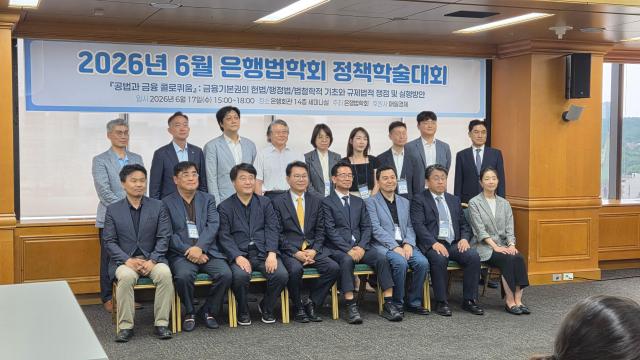
The Bank Law Society held a policy conference on June 17 at the Bankers Association in Jung-gu, Seoul, focusing on the constitutional, administrative, and philosophical foundations of financial rights, as well as regulatory issues and implementation strategies. Attendees are seen taking a commemorative photo. [Photo by Kim Ji-yoon]
As the Yoon Suk-yeol administration prioritizes "inclusive finance," discussions on recognizing access to financial services as a fundamental right are gaining momentum. Advocates argue for institutional guarantees of financial access for the underprivileged, aiming to elevate this right to a constitutional level in the long term.
The Bank Law Society convened a policy conference on June 17 at the Bankers Association in Jung-gu, Seoul, under the theme "The Constitutional, Administrative, and Philosophical Foundations of Financial Rights and Regulatory Issues and Implementation Strategies." The conference examined legal frameworks for recognizing financial rights as constitutional rights and discussed measures to enhance financial accessibility. Notable attendees included Kim Ja-bong, president of the Bank Law Society, and Lee Han-joo, the economic and social research council chairman known as a policy mentor to President Yoon.
Financial rights refer to the right of all citizens to access essential financial services without discrimination, establishing a more concrete universal right based on the financial aspects of the right to pursue happiness enshrined in Article 10 of the Constitution. Discussions are currently being led by organizations such as the Credit Recovery Commission and the Korea Inclusive Finance Agency, with over ten lawmakers, including Min Byung-deok of the Democratic Party, planning to introduce a "Basic Financial Security Act" around August.
Conference participants expressed a consensus on the need to institutionalize the concept of financial rights. In his opening remarks, Lee emphasized, "If people are struggling due to a lack of 5 million won or 3 million won, we must enable them to recover from life's risks through finance," advocating for the expansion of financial services into the realm of fundamental rights.
Subsequent presentations and discussions focused on the constitutional basis and institutional realization of financial rights. Professor Seung Yi-do of Korea University Law School stated, "Financial services are essential infrastructure for realizing other fundamental rights, such as freedom of contract, freedom of occupational choice, property rights, and freedom of movement in a capitalist market economy," suggesting that the Constitutional Court could derive financial rights through current constitutional interpretations. However, he cautioned that excessive expansion of financial rights could conflict with banks' operational freedoms and financial soundness, necessitating a balanced approach.
Kim proposed specific policy measures to enhance financial accessibility, arguing for the establishment of account opening rights for all residents, similar to the basic account systems in the UK and Germany. He also suggested mandatory inclusive finance and a review of banking consolidation laws as long-term goals for realizing financial rights. Professor Lee Jae-hoon of Hankuk University of Foreign Studies discussed rationalizing regulations related to joint branch openings to address financial exclusion among the elderly and other underserved groups.
Discussant Seo Jeong-hee, a former economics professor at Seoul National University, noted that the domestic account ownership rate has already reached 99%, indicating that the focus should shift from financial accessibility to addressing the polarization of financial supply. She remarked, "Low to mid-credit individuals are left in a donut structure within the credit rating system," adding that reforms are needed to reduce the proportion of banks within financial groups through institutional and legal improvements.
* This article has been translated by AI.
Copyright ⓒ Aju Press All rights reserved.