

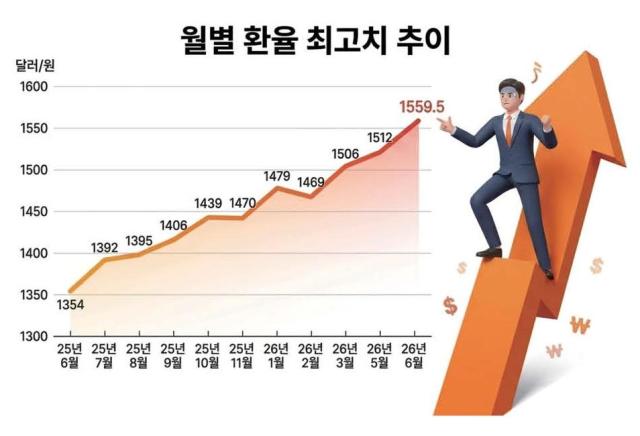
"While it is fortunate that the war in the Middle East has ended, it is difficult to predict how long the challenges posed by high exchange rates will continue," said A, the head of a small steel company focused on exports to the Americas. He added, "With a high reliance on imported raw materials, the burden has increased, and the prolonged high exchange rates have made it difficult to secure orders. Major companies in the automotive and electronics sectors have also moved many of their production bases overseas, making it hard to find work domestically, resulting in a 20-30% drop in sales compared to last year."
Manufacturing SMEs, which heavily depend on imported raw materials and components, are caught in a double bind of 'cost explosions' and 'frozen delivery prices' due to high exchange rates. The soaring won-dollar exchange rate directly translates into increased costs for purchasing raw materials, leading to declining profitability.
According to the small business sector on June 17, the exchange rate has stabilized in the 1500 won range, severely impacting industries such as petrochemicals, metal processing, machinery, and food, which have a high proportion of imported raw materials. These sectors are particularly affected as the prices of basic raw materials are synchronized with the exchange rate, meaning they must bear the cost burden as the rate rises.
The pressure from negotiations over delivery prices with large corporations also weighs heavily on SMEs. Due to a deeply rooted subcontracting structure, SMEs are unable to timely reflect the rising costs in their delivery prices, forcing them to absorb the impacts of high exchange rates.
As of this day, the exchange rate in the Seoul foreign exchange market was 1514 won, an 11.8% increase from 1354 won a year ago in June 2025.
For export-oriented SMEs, which lack hedging tools against exchange rate fluctuations compared to large corporations, the high exchange rate crisis is a significant setback. The prices of imported components needed to manufacture export products have surged, and the steep rise in maritime logistics costs due to global supply chain instability is overwhelming for these small businesses.
Above all, the 'exchange rate volatility' is instilling fear in SMEs. With exchange rates fluctuating by dozens of won in a single day, these companies, lacking infrastructure for managing exchange rate risks, are unable to gauge their raw material order quantities for next month, let alone their business plans for the coming year.
According to a study on exchange rate risk analysis for SMEs published by the Small and Medium Business Administration in September last year, exchange rate risks account for up to 25% of the operating profit for manufacturing SMEs. It was confirmed that a 1% increase in the won-dollar exchange rate results in approximately a 0.36% increase in exchange rate losses.
Consequently, there are calls to ensure that SMEs do not bear the current high exchange rate crisis alone. Kim Dae-jong, a professor at Sejong University, stated, "The dual cost crisis faced by SMEs is not just an issue for individual companies, but a structural disaster resulting from macroeconomic shocks. It is essential to enhance the mandatory nature of delivery price linkage under a proactive government policy for exchange rate stability, and to create a structure that allows SMEs to generate high added value through bold regulatory reforms and support for digital transformation."
* This article has been translated by AI.
Copyright ⓒ Aju Press All rights reserved.