

Google DeepMind has identified video games as a significant testing ground for artificial intelligence (AI) research. The company aims to combine AI agents that understand language instructions and respond to user actions within complex 3D environments, ultimately extending this research to real-world applications.
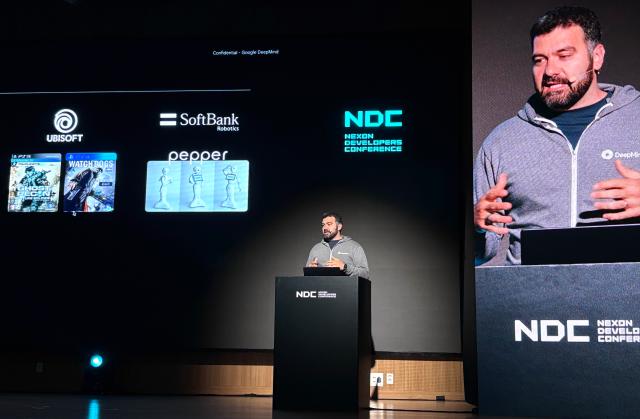
Alexandre Mufarech, Director of Google DeepMind, presented a session titled "How Google DeepMind Advances AI Research Through Video Games" at the Nexon Developer Conference 2026 (NDC) held on June 17 in Seongnam, South Korea.
Mufarech stated, "Games provide a minimal model for learning more complex dynamics," emphasizing their role as a foundational element of DeepMind's research program. He noted that the company has expanded AI reasoning, planning, and adaptability through game-based research, building on successes with AlphaGo, AlphaZero, and AlphaStar.
DeepMind's current focus is on the AI agent SIMA and the world model Genie. SIMA is an embodied AI agent that understands natural language commands in a 3D environment. It operates by recognizing only the pixels on the user's screen and manipulating characters through keyboard and mouse inputs, without relying on internal game data or separate application programming interfaces (APIs).
Mufarech emphasized that SIMA is not designed to excel in specific games but aims to function as a general agent across various environments. He explained, "The core goal of SIMA research is to generalize to environments it has never encountered before," noting that a complex and rich set of games serves as the foundation for this research.
Genie, the world model, creates the environment in which the agent operates, simulating the dynamics of the world in response to user actions. DeepMind introduced Genie1 in February 2024, showcasing a short interactive environment based on a 2D platform game. Subsequently, Genie2 expanded into a 3D fantasy world, while Genie3, released last year, supports 24 frames per second generation, real-time interaction, and rendering up to 720p.
Genie3 features world consistency and "promptable world events," allowing the model to remember changes made by users and insert new events as prompts even after generation begins. Mufarech described this as similar to scripted events in video games.
DeepMind is integrating SIMA and Genie to create a cyclical research structure where AI agents act in generated virtual worlds, using the outcomes to improve the models.
However, Mufarech drew a line against the notion that AI could replace game creators. He stated, "Creating a realistic 3D world does not make it a game; games require story, gameplay, tension, and the creator's vision." He explained that AI could serve as a tool to express visions in new ways rather than replacing creators.
Collaboration with the gaming industry is also emphasized. DeepMind trains AI agents with the consent of game developers and is currently working with the development team of the massive multiplayer online game (MMO) EVE Online. This game, with its persistent world and player-driven economy, provides an ideal environment for studying long-term planning, memory, and multiplayer interactions.
Mufarech stated, "We must explore what AI research can do for games and confirm through iterative experiments whether we can create new player experiences and game experiences that would be impossible without AI."
* This article has been translated by AI.
Copyright ⓒ Aju Press All rights reserved.