Semiconductor Department Admissions Increase by 12%, Non-Contract Programs Expand by 20.9%
by BAEK DUSANPosted : June 18, 2026, 06:32Updated : June 18, 2026, 06:32
Share
facebook
twitter
URL
Text size
[Photo by Yonhap News]
As the artificial intelligence (AI) industry grows, competition for skilled semiconductor workers is intensifying, leading to notable changes in the admissions landscape for semiconductor-related programs at universities in Seoul. While the enrollment for contract programs, which guarantee employment with major companies like Samsung Electronics and SK Hynix, remained unchanged from last year, the number of admissions for non-contract semiconductor programs increased by over 20%, driving overall enrollment growth.
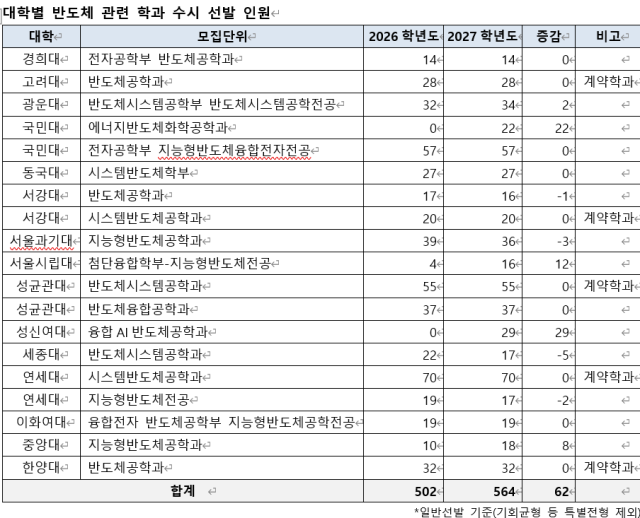
On June 17, Jinhaksa, an admissions information platform, reported that the total number of early admissions for semiconductor-related programs at Seoul universities for the 2027 academic year is 564. This marks an increase of 62 students (12.4%) from last year's 502 admissions across 14 institutions, with one additional school participating this year.
Despite the overall growth trend, the fortunes of contract and non-contract programs diverged. The five major universities—Korea University, Sogang University, Sungkyunkwan University, Yonsei University, and Hanyang University—maintained their contract program admissions at a total of 205, consistent with the previous year.
In contrast, admissions for non-contract semiconductor programs rose from 297 last year to 359 this year, an increase of 62 students, or 20.9%. This indicates that non-contract programs effectively accounted for the entire increase in semiconductor-related admissions this year.
The expansion of non-contract programs is attributed to the establishment of new departments and the increase in existing program capacities. Kookmin University rebranded its Department of Applied Chemistry with a focus on Nano Materials to the Department of Energy Semiconductor Chemical Engineering, boosting its admissions from 57 to 79. Additionally, Sookmyung Women's University introduced a new program in Converged AI Semiconductor Engineering, admitting 29 new students.
Some universities significantly increased their admissions while maintaining their program structures. The Intelligent Semiconductor major at the University of Seoul expanded its admissions from 4 to 16, while Chung-Ang University's Intelligent Semiconductor Engineering program increased from 10 to 18. Kwangwoon University also grew its Semiconductor System Engineering program from 32 to 34 students.
Examining the admissions methods, the increase in the student record comprehensive evaluation method was the most significant. The number of admissions through this method for semiconductor programs in Seoul rose from 310 in the 2026 academic year to 352 in 2027, an increase of 42 students. In comparison, admissions through the student record subject evaluation method rose from 117 to 127, and the essay evaluation method increased from 75 to 85, each by 10 students.
[Chart provided by Jinhaksa]
The trend of diversifying admissions methods is also evident. The University of Seoul's Intelligent Semiconductor major, which only admitted 4 students through the subject evaluation method last year, has increased that number to 6 while introducing the comprehensive evaluation method to admit an additional 10 students this year.
Chung-Ang University has also shifted from solely using the comprehensive evaluation method for 10 admissions last year to incorporating various selection pathways, including essay evaluations, to attract top talent.
Admissions experts predict that due to government support and investments in industry-academia collaboration, student interest in both contract and non-contract semiconductor programs will continue to rise. Jinhaksa's admissions strategy research director, Woo Hyun-cheol, stated, "While interest in semiconductor programs has traditionally focused on contract programs with Samsung Electronics and SK Hynix, this year we are seeing a clear expansion in non-contract semiconductor programs as well. Students now have a broader range of options beyond contract programs, making it essential to carefully examine each program's curriculum and admissions methods."