

Although a highly anticipated bilateral meeting with President Donald Trump did not take place, the two leaders engaged in about two hours of conversation during a dinner.
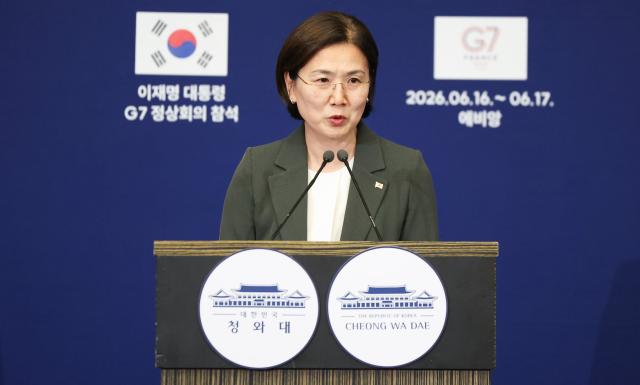
Oh Hyun-joo, Deputy Director of the National Security Office, briefed reporters at the press center in Geneva on June 17, stating, "Three documents related to development, Ebola, and cancer were adopted the previous day, and the remaining five documents are expected to be adopted today."
The Blue House noted that attending the G7 summit for two consecutive years has solidified South Korea's status as a global responsible power aiming for G7+. This marks the first time since the Lee Myung-bak administration in 2008 and 2009 that South Korea has attended the summit for two years in a row.
Oh stated, "Having served as the chair of the UN Security Council and APEC, we are set to assume the G20 presidency in 2028. Being invited to the G7 summit for two consecutive years demonstrates the international community's trust and expectations regarding our global status and role."
A key official from the Blue House remarked, "President Trump expressed a strong willingness to play a necessary role in advancing issues on the Korean Peninsula and indicated he would consider ways to contribute to peace in the region. He also mentioned that he would maintain close communication with President Lee on these matters."
Trump reportedly described President Lee as a 'strong leader.'
Oh emphasized, "Our country is actively participating in international solidarity to address global issues and has expressed its intention to lead relevant agendas as the G20 chair in 2028. The government plans to strengthen policy cooperation with the G7 in various fields, including development, health, and digital matters, by joining most of the agreements adopted by G7 leaders at the summit."
He further highlighted that President Lee stressed the importance of resolving global economic imbalances through solidarity and dialogue rather than assigning blame. He also pointed out the need to promote innovation in various fields, including AI, while ensuring stability, transparency, and accountability.
Additionally, he proposed seeking systematic solutions through mutual solidarity and cooperation to enhance the resilience of global energy supply chains.
Oh elaborated that the recent disruptions in oil supply due to the situation in the Middle East have expanded into a complex crisis affecting the overall oil product supply chain and inflation, revealing greater vulnerabilities in the energy supply chain in the Asia-Pacific region compared to other areas.
He explained that the aim is to explore practical cooperation measures beyond individual country responses among energy-importing countries, especially in the Asia-Pacific region, including information sharing, early warning systems, emergency cooperation, and stabilization of oil and oil product supply chains.
Oh stated, "We plan to utilize the existing global energy security framework to discuss specific cooperation measures in Asia with the IEA (International Energy Agency) Secretariat and key countries. We aim to provide necessary support to ensure that the IEA Singapore Regional Cooperation Center can function as a practical hub for energy security cooperation in Asia."
Furthermore, he mentioned that the South Korean government intends to propose the establishment of a system to enhance the resilience of energy supply chains among energy-importing countries in the Asia-Pacific region based on these discussions, aiming to facilitate practical cooperation measures such as information sharing, early warning systems, and strengthening supply chain resilience.
The Blue House also emphasized the significance of securing a momentum for practical diplomacy centered on national interests through participation in this G7 summit.
Leaders discussed building new partnerships, achieving balanced economic growth, and ensuring safe, rapid, and efficient AI implementation, with participation from G7 member countries, South Korea, and five invited nations, along with major international organizations.
* This article has been translated by AI.
Copyright ⓒ Aju Press All rights reserved.