

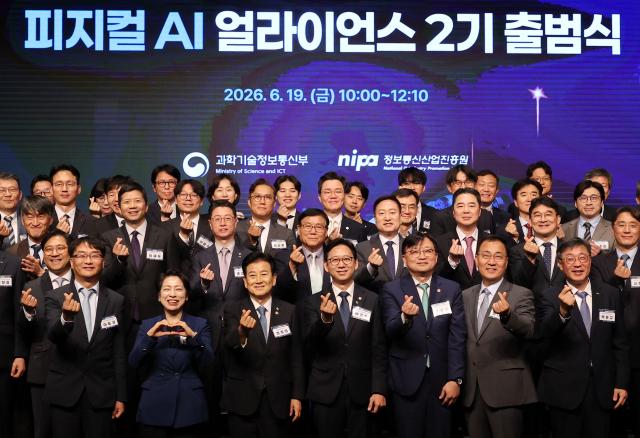
As the United States and China accelerate their competition for leadership in physical AI, South Korea's Ministry of Science and ICT is restructuring the Physical AI Alliance, a consortium of academia, industry, and research. The initiative aims to establish a Korean full-stack ecosystem that goes beyond mere technical discussions, transforming into an operational organization that connects AI models, semiconductors, robotics, and data to spread physical AI across manufacturing, healthcare, and defense sectors, thereby enhancing the nation's competitive edge.
At the launch of the Physical AI Alliance 2.0 on June 19 at The Plaza Hotel in Seoul, Deputy Prime Minister and Minister of Science and ICT Baek Kyung-hoon stated, "The second phase of physical AI aims to compete effectively in the global market. Although we are still in the early stages, this is a field where South Korea must secure leadership."
The event was attended by over 200 participants, including lawmakers Jeong Dong-young, Choi Hyung-doo, and Hwang Jeong-a, KOSA Chairman Cho Jun-hee, heads of the National IT Industry Promotion Agency (NIPA), the Institute for Information and Communications Technology Planning and Evaluation (IITP), and the National Information Society Agency (NIA), as well as experts from academia and industry.
Baek defined physical AI as AI that is applied across various real-world sectors, including manufacturing, public services, defense, healthcare, and daily life. He noted, "Physical AI is the transition of AI from operating on computers to the real world. Without developing our own AI capabilities, we will inevitably depend on specific countries or companies."
He added, "To elevate South Korea to one of the top three AI powerhouses, we must establish a system to secure on-site data. It is crucial to create a foundation for accumulating and utilizing data related to physical AI."
Chairman Cho emphasized the necessity of collaboration among companies to build a physical AI ecosystem. He remarked, "If individual companies operate separately, only component manufacturers will remain, making it difficult to create a complete physical AI ecosystem. We need to integrate key elements such as world models, robotic foundation models, domestically produced neural processing units (NPUs), manufacturing data, and high-bandwidth memory (HBM) to establish a full-stack ecosystem."
He cautioned that reliance on U.S. big tech models could lead to the subordination of South Korea's robotics and components industries, stressing the need to create an independent ecosystem based on the country's strengths in manufacturing data and semiconductor competitiveness.
In response, the Ministry of Science and ICT plans to transform the Physical AI Alliance into an operational platform that identifies and promotes actual projects. Lee Joo-sik, head of the ministry's ICT Industry Policy Division, explained, "While the first phase connected the physical AI ecosystem and set directions, the second phase aims to create a structure that spans technology development, validation, and commercialization based on industry demand."
The operational framework will consist of three pillars: technology independence, industrial application, and foundational governance. Each pillar will have action groups involving experts from academia, industry, and research to identify and advance real projects.
The technology independence pillar aims to establish a Korean physical AI full stack by linking AI models with robotics, sensors, domestic NPUs, data centers, and development tools to reduce dependence on foreign big tech.
The industrial application pillar will focus on discovering demand-driven projects and expanding on-site applications through action groups centered on sectors such as healthcare and wellness, autonomous driving and logistics, and everyday services.
The foundational governance pillar will oversee standards, regulations, safety, communication, and global cooperation. It will be responsible for establishing safety standards, data utilization systems, communication infrastructure, security frameworks, and strategies for international expansion, with participation from KAIST, the Korea Telecommunications Technology Association (TTA), relevant associations, and global cooperation agencies.
Lee stated, "Starting in the second half of the year, we plan to advance three key tasks: building a Korean physical AI platform, establishing data learning hubs, and creating a regulatory foundation. We aim to link these with new budget projects in 2027 to develop into an effective organization that delivers tangible results."
* This article has been translated by AI.
Copyright ⓒ Aju Press All rights reserved.