

SEOUL, August 04 (AJP) -The legal foundation for U.S. tariffs on goods from South Korea and 59 other trading partners came under challenge Monday as a coalition of 25 Democratic-led states sued the Trump administration in federal court.
Many nonexempt South Korean goods entering the United States have faced a combined tariff rate of 12.5 percent since July 24, after Washington replaced an expiring 10 percent global surcharge with new duties imposed under Section 301 of the Trade Act of 1974.
Under the measure, the United States imposes an additional duty on South Korean products when their existing most-favored-nation tariff is below 12.5 percent, bringing the combined rate to that level. Products whose existing rate is already at least 12.5 percent receive no additional Section 301 duty. Goods subject to separate Section 232 national security tariffs, including automobiles, steel, aluminum and copper, are excluded from this particular action but may still face other U.S. duties.
A coalition of 25 Democratic-led U.S. states filed a lawsuit Monday in the U.S. Court of International Trade in New York, asking the court to halt the "unlawful" tariffs and refund duties already collected.
The lawsuit includes New York, California, Oregon, Arizona, Washington, Massachusetts, Michigan, New Jersey, Pennsylvania and 16 other states.
The Trump administration imposed duties of between 10 percent and 12.5 percent on imports from 59 countries and the European Union, collectively accounting for more than 99 percent of U.S. imports. Washington said the economies had failed to impose or effectively enforce bans on imports made wholly or partly with forced labor.
The states, however, argue that forced labor was used as a pretext to preserve President Donald Trump’s broad global tariff policy after courts invalidated two previous versions.
Their complaint said the Office of the U.S. Trade Representative grouped 60 economies into just four tariff categories without establishing a meaningful relationship between conditions in each economy and the rate imposed. It also alleged that USTR provided no clear benchmarks explaining how a country could improve its forced-labor enforcement and secure the removal of the tariffs.
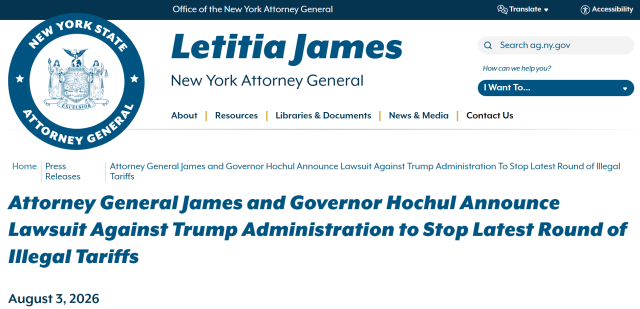
“The law and our Constitution are clear that the president does not have the power to impose sweeping tariffs on whatever countries he wants,” New York Attorney General Letitia James said in a statement announcing the lawsuit.
James said the tariffs would effectively raise taxes on American families and businesses by increasing the prices of imported products.
The White House rejected the states’ claims, saying Section 301 explicitly permits the government to respond to foreign practices that unfairly burden U.S. commerce.
“The United States is using its lawful authority to obtain the elimination of unreasonable acts, policies, and practices that burden U.S. commerce,” White House spokesperson Kush Desai said.
Desai said weak enforcement of forced-labor import bans placed American workers and businesses at a competitive disadvantage and argued that Section 301 had proved legally durable during Trump’s first term.
The current dispute follows a series of courtroom setbacks for Trump’s tariff agenda. In February, the U.S. Supreme Court ruled that the International Emergency Economic Powers Act did not authorize the president to impose the sweeping “reciprocal” tariffs introduced during his second term.
The administration subsequently imposed a temporary 10 percent worldwide surcharge for 150 days under Section 122 of the Trade Act. The Court of International Trade also ruled against that measure, although it remained in place during the government’s appeal and expired at the beginning of July 24. The new Section 301 tariffs took effect at the same time, preventing any interruption in the administration’s baseline tariff policy.
Unlike the emergency-powers and Section 122 provisions, Section 301 has long been used to address unfair or discriminatory foreign trade practices. Trump relied on it extensively to impose tariffs on Chinese products during his first term, and those duties survived previous legal challenges.
The states nevertheless argue that Section 301 requires investigations and remedies tailored to specific countries and practices. They said completing investigations into 60 separate economies in less than three months and imposing nearly identical rates demonstrated that the outcome had been predetermined.
The states’ case follows two lawsuits filed by U.S. small businesses on July 24, the day the new tariffs took effect. One was brought on behalf of New York spice retailer Burlap & Barrel and California watch retailer Collective Horology. Those plaintiffs similarly contend that the administration did not explain how tariffs on their imports would eliminate the foreign practices identified by USTR.
The latest lawsuit could determine whether the administration can use Section 301 to sustain tariffs covering nearly the entire U.S. import market or whether the law permits only narrower measures directed at clearly identified trade practices.
Copyright ⓒ Aju Press All rights reserved.
