The average delinquency rate on won-denominated loans at KB Kookmin, Shinhan, Hana, Woori and NH NongHyup stood at 0.51 percent at the end of May, according to financial industry data released Monday.
That was up 0.05 percentage point from 0.46 percent a month earlier and 0.14 percentage point from 0.37 percent at the end of last year.
The deterioration was most pronounced among SMEs. Their average delinquency rate at the five banks reached 0.73 percent at the end of May, the highest since comparable data became available in January 2020.
The figure rose from 0.50 percent at the end of last year to 0.65 percent at the end of April, before climbing another 0.08 percentage point in May alone.
By comparison, the delinquency rate for loans to large companies rose to 0.09 percent from 0.03 percent over the same period. The delinquency rate for household loans increased more moderately to 0.35 percent from 0.30 percent.
Signs of deeper credit stress also widened. The five banks’ average substandard-or-below loan ratio for won-denominated loans stood at 0.44 percent at the end of May.
For SMEs, the ratio reached 0.68 percent, also the highest level in data going back to January 2020. That was more than twice the level for large companies at 0.30 percent and households at 0.27 percent.
Substandard-or-below loans refer to loans classified as difficult to recover normally, including loans overdue for three months or longer. The increase suggests that rising delinquencies are beginning to translate into a broader buildup of bad loans.
Individual banks also showed sharp deterioration in SME loan quality. At some banks, SME delinquency rates rose to their highest levels since 2016, pointing to the most severe repayment pressure in about a decade.
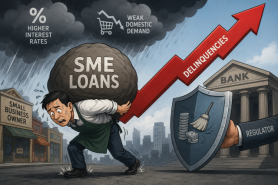
Analysts say smaller companies are being squeezed by a combination of higher oil prices, a weaker won and rising market interest rates. The Middle East war has increased energy and raw material costs, while the won’s depreciation has raised import bills.
Borrowing costs have also moved higher. The three-year Korean Treasury bond yield stood at 3.731 percent at the end of May, up 13.6 basis points from the end of April, according to the Korea Financial Investment Association. The 10-year and 30-year yields rose 14.5 basis points and 21.6 basis points, respectively.
Higher market rates tend to feed into bank lending rates with a lag. SMEs and self-employed borrowers are particularly vulnerable because they depend more heavily on bank loans than large corporations and often carry a higher share of floating-rate debt.
The data also point to a widening divide between export-led large manufacturers and domestic demand-oriented small businesses. While semiconductor exports have supported Korea’s headline trade recovery, many smaller firms in services, real estate and rental businesses are facing weaker cash flows.
A commercial bank official said delinquency rates were rising quickly among SMEs in real estate, rental and service sectors, warning that the credit-quality gap by company size could widen further if domestic and external uncertainties persist.
Financial authorities are monitoring the trend closely. The Financial Supervisory Service said earlier that the delinquency rate on won-denominated loans at domestic banks rose to 0.61 percent at the end of April, up 0.05 percentage point from a month earlier, and pledged to encourage banks to strengthen loss-absorbing capacity and support debt restructuring for vulnerable borrowers.

Copyright ⓒ Aju Press All rights reserved.