

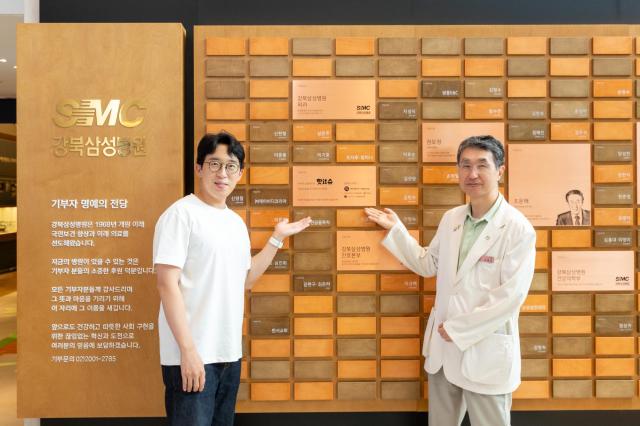
Kangbuk Samsung Hospital, affiliated with Sungkyunkwan University, announced on June 24 that YouTuber Itsub and Naver Shopping Live have donated funds and supplies to support high-risk newborn care. The total donation amounts to 107.2 million won, which includes 70.8 million won in cash and 36.4 million won in goods.
The funds will be used to assist families facing economic hardships with high-risk newborns.
In addition to Itsub and Naver Shopping Live, eight companies, including Sony Korea, Nescafe Dolce Gusto, Linkle, Rove, Brezza, Roborock, Dreamy, and Yous, contributed in-kind donations.
The hospital stated, "The donated items are essential supplies that will provide practical help to high-risk newborns and single mothers."
Kangbuk Samsung Hospital is equipped with specialized infrastructure for the care of high-risk mothers and newborns, offering top-level intensive care for critically ill infants.
A hospital representative said, "We will use the donations to provide thorough support for families of high-risk newborns facing economic difficulties and will continue to expand our medical social contribution activities for vulnerable groups in the community."
Meanwhile, a research team led by Professor Jeon Ga-won of the Department of Pediatrics at Kangbuk Samsung Hospital recently analyzed 919 extremely premature infants born between 22 and 23 weeks of gestation in South Korea from 2013 to 2022, comparing survival rates and treatment outcomes based on the level of care at different institutions.
The study found that the survival rates of extremely premature infants born at the threshold of viability (22-23 weeks) varied by more than two times depending on the medical staff's expertise and the treatment system in place. The research confirmed that differences in survival rates stem from the capabilities of the personnel and the systems in operation, rather than merely the availability of medical equipment.
* This article has been translated by AI.
Copyright ⓒ Aju Press All rights reserved.