

Although the number of medical school admissions for the 2027 academic year has significantly increased, the general admissions process, which is open to all applicants regardless of residency, has become more restrictive. Analysts in the education sector suggest that the explosive growth in the regional selection ratio at non-metropolitan medical schools has effectively blocked access for students from the capital region seeking to attend these institutions.
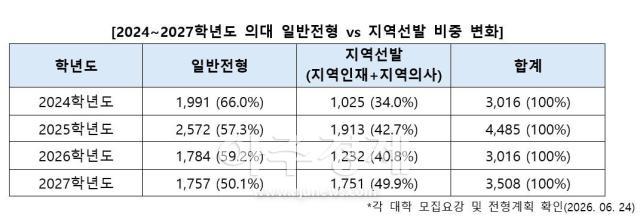
According to a report released on June 24 by JinHakSa, the total number of medical school admissions nationwide for the 2027 academic year is set at 3,508, including 488 spots for the newly established regional physician selection program. This marks an increase of 492 from the previous year’s total of 3,016.
However, the general admissions category, which allows applicants to apply without residency restrictions, has decreased to 1,757, down 27 from last year’s 1,784. This represents a sharp decline of 11.8% (234 spots) compared to the 2024 academic year, which had 1,991 general admissions.
As a result, the ratio of general admissions to regional selections (including local talent and regional physicians) has narrowed to approximately 50.1% to 49.9%, creating a near 5-to-5 balance.
Notably, the regional bias in non-metropolitan medical schools has intensified, with 69.4% of the admissions slots (7 out of 10) allocated to local students.
According to a report released on June 24 by JinHakSa, the total number of medical school admissions nationwide for the 2027 academic year is set at 3,508, including 488 spots for the newly established regional physician selection program. This marks an increase of 492 from the previous year’s total of 3,016.
However, the general admissions category, which allows applicants to apply without residency restrictions, has decreased to 1,757, down 27 from last year’s 1,784. This represents a sharp decline of 11.8% (234 spots) compared to the 2024 academic year, which had 1,991 general admissions.
As a result, the ratio of general admissions to regional selections (including local talent and regional physicians) has narrowed to approximately 50.1% to 49.9%, creating a near 5-to-5 balance.
Notably, the regional bias in non-metropolitan medical schools has intensified, with 69.4% of the admissions slots (7 out of 10) allocated to local students.
An additional analysis of detailed admissions data by JinHakSa reveals stark disparities in regional selection barriers. In the Gwangju and Jeolla region, out of a total of 573 medical school admissions, 443 were filled through regional selection, resulting in an impressive 77.3% ratio. This was followed by Jeju (76.5%), Busan, Ulsan, and Gyeongnam (72.8%), Daegu and Gyeongbuk (70.9%), and Daejeon and Chungcheong (69.6%), all showing overwhelming majorities in regional selections.
At the individual university level, the situation is even more pronounced. Dong-A University allocated 56 out of 66 total admissions to regional selection, achieving the highest rate at 84.8%. Chonnam National University (84.0%), Gyeongsang National University (83.7%), Wonkwang University (83.6%), and Dongguk University WISE (83.3%) also confirmed that over 80% of their new students are from local areas.
Conversely, the university with the largest reduction in general admissions available to capital region students was Soonchunhyang University, which saw a decrease of 18 spots, followed by Dongguk University WISE (-7 spots) and Gyeongsang National University (-6 spots).
Distinct differences are also evident in the types of admissions processes. General admissions are primarily based on regular admissions, which account for 41.3% (726 spots), followed by comprehensive student evaluations at 35.7% (628 spots). In contrast, regional selections are dominated by academic performance evaluations, which comprise 50.5% of the process. This shift in admissions structure means that applicants' strategies will need to adapt significantly based on their residency.
This trend reflects not just an expansion of medical school capacity but also the government's commitment to enhancing regional talent selection, which has become more pronounced in the admissions process for the 2027 academic year. The medical school admissions paradigm is rapidly shifting from a nationwide competition to a regional league, suggesting that residency will become a crucial factor in applicants' profiles.
Yoo An-cheol, head of JinHakSa's admissions strategy research center, stated, "The most significant change in medical school admissions recently is not the increase in the number of spots, but rather the shift in the selection criteria. Students now need to assess not just how many spots are available, but how many of those spots they are eligible to apply for."
He added, "Students who meet the qualifications for regional selection should actively utilize the expanded regional selection tracks, while those preparing for general admissions need to focus their efforts on the types of admissions that align with their strengths, such as regular admissions and comprehensive evaluations."
At the individual university level, the situation is even more pronounced. Dong-A University allocated 56 out of 66 total admissions to regional selection, achieving the highest rate at 84.8%. Chonnam National University (84.0%), Gyeongsang National University (83.7%), Wonkwang University (83.6%), and Dongguk University WISE (83.3%) also confirmed that over 80% of their new students are from local areas.
Conversely, the university with the largest reduction in general admissions available to capital region students was Soonchunhyang University, which saw a decrease of 18 spots, followed by Dongguk University WISE (-7 spots) and Gyeongsang National University (-6 spots).
Distinct differences are also evident in the types of admissions processes. General admissions are primarily based on regular admissions, which account for 41.3% (726 spots), followed by comprehensive student evaluations at 35.7% (628 spots). In contrast, regional selections are dominated by academic performance evaluations, which comprise 50.5% of the process. This shift in admissions structure means that applicants' strategies will need to adapt significantly based on their residency.
This trend reflects not just an expansion of medical school capacity but also the government's commitment to enhancing regional talent selection, which has become more pronounced in the admissions process for the 2027 academic year. The medical school admissions paradigm is rapidly shifting from a nationwide competition to a regional league, suggesting that residency will become a crucial factor in applicants' profiles.
Yoo An-cheol, head of JinHakSa's admissions strategy research center, stated, "The most significant change in medical school admissions recently is not the increase in the number of spots, but rather the shift in the selection criteria. Students now need to assess not just how many spots are available, but how many of those spots they are eligible to apply for."
He added, "Students who meet the qualifications for regional selection should actively utilize the expanded regional selection tracks, while those preparing for general admissions need to focus their efforts on the types of admissions that align with their strengths, such as regular admissions and comprehensive evaluations."
* This article has been translated by AI.
Copyright ⓒ Aju Press All rights reserved.