

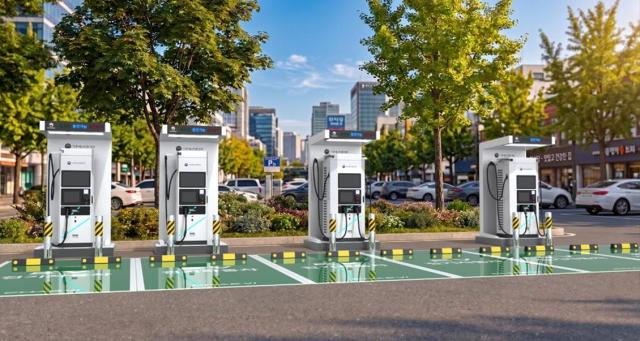
Chaevi, a domestic operator of electric vehicle fast charging infrastructure, has secured contracts for public fast charger installation projects from both the government and the Seoul Metropolitan Government.
On June 25, Chaevi announced that it has been awarded the "2026 Electric Vehicle Public Fast Charger Manufacturing and Purchasing Project" by the Korea Environmental Corporation, under the Ministry of Climate, Energy and Environment, as well as the "2026 Seoul Public Electric Vehicle Charging Facility Manufacturing and Purchasing Project" promoted by the Seoul Energy Corporation.
In the project with the Korea Environmental Corporation, Chaevi has been selected as the contractor for the Yeongnam region, which includes Busan, Daegu, Ulsan, Gyeongnam, and Gyeongbuk. This project will see the installation of 136 standalone chargers with a capacity of 100 kW and 113 simultaneous chargers with a capacity of 200 kW along major travel routes nationwide.
For the Seoul project, Chaevi plans to establish 12 dual fast chargers with capacities of 100 kW and 200 kW, along with eight canopies at public facilities in Seoul by December of this year. Through these two projects, Chaevi will manufacture, deliver, and install a total of over 260 public fast chargers.
The government aims to expand public charging infrastructure, targeting the installation of over 1.23 million electric vehicle chargers, including 145,000 fast chargers, by 2030. Chaevi intends to use this contract win to further expand its public charging infrastructure development and operation business.
Chaevi CEO Choi Young-hoon stated, "This project selection is a recognition of our charger manufacturing technology and our capabilities in building and operating public charging infrastructure. The experience and data we have accumulated from directly operating chargers have become our unique competitive advantage in product development."
Meanwhile, Chaevi reported a revenue of 20.7 billion won in the first quarter of this year, marking a 21% increase compared to the previous year. Notably, the charging service sector generated 13.9 billion won in revenue, continuing its growth trend. The company recorded an operating loss of 9.7 billion won, reducing its deficit compared to the previous year's loss of 10.5 billion won.
* This article has been translated by AI.
Copyright ⓒ Aju Press All rights reserved.