

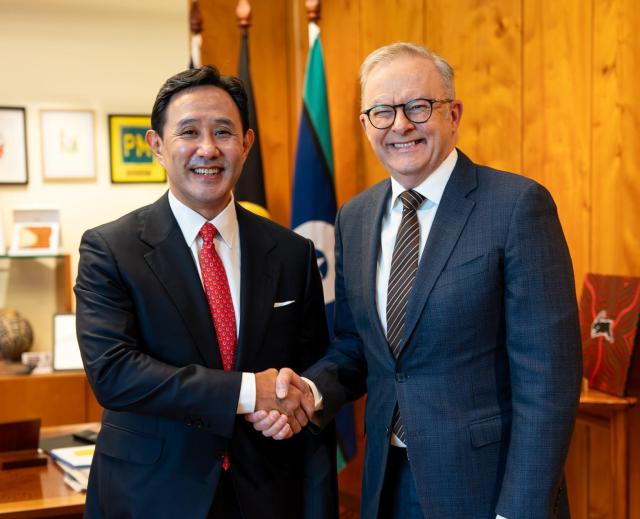
On June 25, Korea Zinc reported that Chairman Choi Yoon-bum met with Prime Minister Anthony Albanese to discuss the need to enhance Australia’s critical mineral supply chain and the competitiveness of its smelting industry.
The meeting took place on June 24 at the Prime Minister's office in Canberra. Albanese began by highlighting Choi's achievements during his tenure as CEO of Sun Metals Corporation (SMC), a Korea Zinc subsidiary based in Townsville, Australia, stating, "Korea Zinc is a trusted company with proven operational capabilities in Australia."
He added, "Choi Yoon-bum, who served as CEO of SMC for a significant period, has a deep understanding of Australia’s industrial environment and community coexistence, making Korea Zinc a company that aligns well with the Australian government's resource and energy policy direction."
Albanese cited examples of Korea Zinc's initiatives, including not only the operation of smelters but also the procurement of renewable energy through solar and wind power, as well as the promotion of green hydrogen projects.
In response, Choi stated, "We have been a partner contributing to and investing in the local industry and community in Australia for the past 30 years, expanding our business beyond smelting to renewable energy and green hydrogen. The abundant resources of Australia combined with Korea Zinc's technological expertise and diverse business portfolio will continue to create various synergies in the future."
During the discussion, they also addressed Project Crucible, a construction initiative for an integrated smelter in Tennessee that Korea Zinc is pursuing in collaboration with the U.S. government. Project Crucible is recognized as a key effort to establish a critical mineral supply chain and enhance strategic mineral self-sufficiency in the United States.
Choi explained that the combination of Korea Zinc's technological capabilities and the U.S. government's policy support is facilitating the stabilization of the critical mineral supply chain. Albanese responded that Project Crucible serves as a good example for the Australian government to benchmark and suggested enhancing communication to address challenges facing the Australian smelting industry.
The Australian federal government announced its critical mineral strategy in 2023, aiming to secure a stable mineral supply chain in response to geopolitical supply chain risks through the 'Critical Mineral Production Framework.'
This meeting is particularly significant as it occurred amid escalating competition between the U.S. and China over critical minerals. As the U.S. and Australia accelerate efforts to build a supply chain independent of China, Korea Zinc is being recognized as a strategic partner connecting the critical mineral supply chains of both countries, leveraging its world-class non-ferrous metal smelting technology.
Industry experts believe that the expansion of Korea Zinc's local operations in Australia, coupled with Project Crucible in the U.S., will further enhance the company's strategy for building a global critical mineral value chain.
Since establishing SMC in 1996, Korea Zinc has positioned itself as a key industrial partner in Australia for 30 years, expanding its operations from smelting to renewable energy and green hydrogen.
* This article has been translated by AI.
Copyright ⓒ Aju Press All rights reserved.