

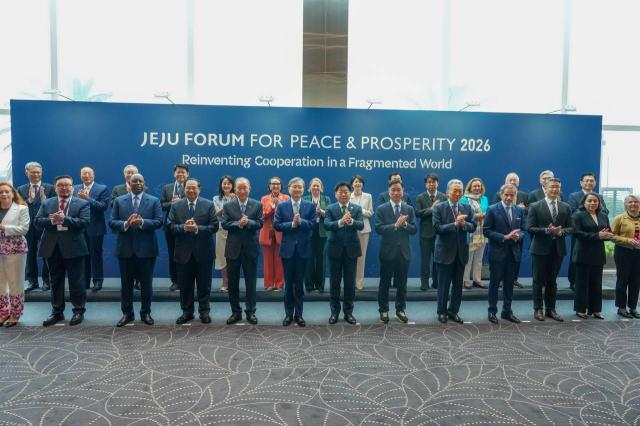
“We must actively discuss peace to create a true peace where there is no need for conflict. South Korea will fulfill its role and contributions as a global responsible nation by leading international cooperation for peace and prosperity through events like the Jeju Forum.”
President Lee Jae-myung made these remarks in a video message during the opening ceremony of the 21st Jeju Forum for Peace and Prosperity held at the Haevichi Hotel in Seogwipo, Jeju, on June 25.
Under the main theme of “Reinventing Cooperation in a Fragmented World,” the forum attracted over 4,500 participants, including current and former leaders and senior officials from various countries and international organizations, as well as experts from academia and civil society.
President Lee emphasized that “the challenges the world faces cannot be solved by the power of just one or two countries,” adding that “when capable countries create flexible cooperative networks, they can fill the gaps in the existing international order.”
United Nations Secretary-General António Guterres, in his video address, reaffirmed the commitment to the UN Charter through “Reinventing Cooperation,” stressing that today’s multilateralism must be more connected, inclusive, and representative. He praised the Jeju Forum for its efforts to listen to diverse voices beyond established powers.
Slovenian President Nataša Pirc Musar, in her video message, stated that middle powers like South Korea and Slovenia must work to uphold multilateralism, engage in minilateralism, and secure roles in governance of new technologies such as AI to address the fragmented realities.
She added that innovative approaches like minilateralism in areas such as critical minerals could provide middle powers with better opportunities to pursue their national interests.
Indian Foreign Minister Subrahmanyam Jaishankar attended the opening ceremony in person and delivered a keynote speech, noting that the fragmented international order is not entirely negative but has become a structural reality. He emphasized the need for “Reinventing Cooperation” in this environment.
To achieve this, he proposed new cooperative methods that align with the changing international landscape, including international economic de-risking and supply chain diversification, building new cooperative relationships among influential countries, upholding international law and norms, strengthening the capabilities of the Global South, and expanding global public goods through multilateral reform.
Minister Jaishankar remarked, “In India, we say the world is one family,” stressing that it should not be left to a few. He called for the implementation of reformed multilateralism.
He also noted that South Korea and India have high complementarity in areas such as shipbuilding, digital technology, health, infrastructure, and defense, making their cooperation significant on a global scale.
President Lee Jae-myung made these remarks in a video message during the opening ceremony of the 21st Jeju Forum for Peace and Prosperity held at the Haevichi Hotel in Seogwipo, Jeju, on June 25.
Under the main theme of “Reinventing Cooperation in a Fragmented World,” the forum attracted over 4,500 participants, including current and former leaders and senior officials from various countries and international organizations, as well as experts from academia and civil society.
President Lee emphasized that “the challenges the world faces cannot be solved by the power of just one or two countries,” adding that “when capable countries create flexible cooperative networks, they can fill the gaps in the existing international order.”
United Nations Secretary-General António Guterres, in his video address, reaffirmed the commitment to the UN Charter through “Reinventing Cooperation,” stressing that today’s multilateralism must be more connected, inclusive, and representative. He praised the Jeju Forum for its efforts to listen to diverse voices beyond established powers.
Slovenian President Nataša Pirc Musar, in her video message, stated that middle powers like South Korea and Slovenia must work to uphold multilateralism, engage in minilateralism, and secure roles in governance of new technologies such as AI to address the fragmented realities.
She added that innovative approaches like minilateralism in areas such as critical minerals could provide middle powers with better opportunities to pursue their national interests.
Indian Foreign Minister Subrahmanyam Jaishankar attended the opening ceremony in person and delivered a keynote speech, noting that the fragmented international order is not entirely negative but has become a structural reality. He emphasized the need for “Reinventing Cooperation” in this environment.
To achieve this, he proposed new cooperative methods that align with the changing international landscape, including international economic de-risking and supply chain diversification, building new cooperative relationships among influential countries, upholding international law and norms, strengthening the capabilities of the Global South, and expanding global public goods through multilateral reform.
Minister Jaishankar remarked, “In India, we say the world is one family,” stressing that it should not be left to a few. He called for the implementation of reformed multilateralism.
He also noted that South Korea and India have high complementarity in areas such as shipbuilding, digital technology, health, infrastructure, and defense, making their cooperation significant on a global scale.
* This article has been translated by AI.
Copyright ⓒ Aju Press All rights reserved.