
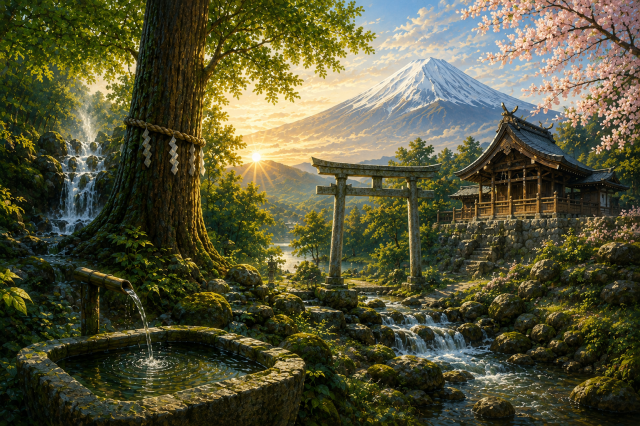
To truly understand Japan, one must first grasp the essence of Shinto (神道). Shinto is the oldest religion and cultural sensibility of the Japanese people, embodying their relationship with nature and connecting them to their ancestors, communities, and nation. When Japanese people gaze upon mountains, they do not merely see terrain; when they look at the sea, they do not just see water. They perceive a sacred energy in ancient trees, rocks, waterfalls, rivers, the sun, and the wind. This perception is the foundation of Shinto.
At the heart of Shinto is the concept of kami (神). While often translated as 'god,' kami differs from the monotheistic concept of an absolute deity in Western religions. Kami can be found in mountains, seas, forests, ancestors, and within the memories of special individuals and communities. The Encyclopaedia Britannica explains that in ancient Shinto, people sought kami in nature and recognized it in exceptional humans.
The head office of Japanese shrines also notes that Shinto lacks a specific founder, doctrine, or scripture, and has been expressed through reverence for nature and ancestors.
This distinction is crucial. Shinto is more a religion of sensation than of doctrine. Feelings take precedence over logic, rituals over scriptures, and purification over confession. Rather than explaining their faith, Japanese people cleanse themselves before kami, bow, clap their hands, and center their minds. They embrace the sacred through space, gestures, and silence rather than through words. Therefore, to understand Shinto, one must go beyond academic study; it requires experiencing the early morning forest paths, standing before the torii gate of a shrine, listening to the sound of water for purification, and witnessing the light filtering through ancient cedars.
The first aspect of Shinto is nature worship. The Japanese archipelago is a land of volcanoes, earthquakes, typhoons, and tsunamis, characterized by its beauty and fear. Cherry blossoms bloom brilliantly but fade quickly, and Mount Fuji, while majestic, carries memories of eruptions. The sea provides fish but also brings disasters. In this environment, the Japanese view nature not as something to conquer but as a presence to soothe and respect. Nature is greater and older than humanity, a force that cannot be recklessly handled.
Thus, in the Shinto worldview, nature is not merely material; it is relational. A single tree is not just wood, and a rock is not merely a stone. A waterfall is not just a phenomenon of falling water; it is a place where sacred power is revealed. A mountain is not merely a hiking trail; it is a space where kami resides. Shinto's perspective on nature does not sharply separate humans from the natural world. Humans are not masters outside of nature but exist within it. This sensibility forms the deep foundation of Japanese culture.
Another characteristic of Shinto is its openness to the possibility of divinity in all things. The phrase 'yaoyorozu no kami (八百万の神)' translates to 'eight million kami,' but its true meaning is countless deities. This implies that sacred energy resides everywhere. This phrase encapsulates the Japanese worldview, suggesting that divinity is not far away in the heavens but present in village corners, rice paddies, kitchens, forests, wells, ancestors, festivals, and seasonal changes.
This worldview has influenced Japanese cultural practices. Japanese people tend to keep their homes clean, organize their belongings, present food with care, and sensitively perceive seasonal changes. While not every Japanese person embodies these traits, a strong sense of 'cleanliness,' 'order,' and 'moderation' permeates Japanese culture. The Shinto purification ritual known as harae (祓) serves as the religious root of this culture. Research from Kokugakuin University indicates that purification rituals are a vital element of Shinto and are deeply connected to the Japanese sense of cleanliness.
In Shinto, impurity is not merely a hygiene issue; it represents disorder, imbalance, and a state that obscures the life force. Therefore, washing hands and rinsing the mouth before entering a shrine is not just a formal courtesy; it is a way to restore order to the mind and body. Humans are imperfect and constantly become dirty and disordered. Thus, they must wash, bow, and begin anew. This embodies a significant aspect of Shinto's spirit.
Here, we see the connection between Shinto and Japan's 'reset culture.' Japan has a tradition of preserving the old while simultaneously rebuilding anew. A prime example is Ise Jingu, one of Japan's most sacred shrines, which has maintained a tradition of reconstruction at regular intervals for centuries. The Associated Press reports that this tradition of rebuilding Ise Jingu has continued for over 1,300 years, symbolizing the spirit of renewal and succession in Shinto.
This tradition is intriguing. Western cultural preservation typically emphasizes the conservation of original materials. However, the approach of Ise Jingu focuses on passing down form, spirit, and technique to the next generation rather than eternally preserving material. Buildings are newly constructed, but the spirit endures. The wood may change, but the rituals continue. People may die, but artisans pass on their skills. This illustrates Shinto's perception of time: eternity is found not in stasis but in repetition and renewal.
Understanding Shinto also requires examining its relationship with Buddhism. After Buddhism was introduced to Japan, Shinto and Buddhism did not only clash but also blended and influenced each other over time. Japanese people pray for their ancestors at temples and seek blessings for the new year at shrines. Many weddings are conducted in Shinto style, while funerals are often held in Buddhist tradition. Practical harmony in daily life has taken precedence over strict doctrinal distinctions, which characterizes Japanese religious culture.
However, Shinto cannot be viewed solely as a beautiful nature religion. While it has fostered warm traditions of community, ancestor worship, and seasonal festivals, it has also revealed a dangerous side when intertwined with nationalism in modern times. The reverence for nature and ancestors is precious, but when it merges with state power and becomes absolute, religion can transform from a liberating force into a tool for mobilizing people.
Therefore, our perspective on Shinto must be balanced. It should neither be idealized nor belittled. There are certainly lessons to be learned from Japanese Shinto: the attitude of not mistreating nature, the importance of remembering ancestors, the culture of maintaining the rhythms of community and seasons, and the habit of managing spaces with care are values that humanity today must reconsider. In an era of climate and ecological crises, viewing nature merely as a resource has reached its limits. In this regard, Shinto's perspective on nature offers a message to the modern world.
At the same time, we must critically examine how Shinto has historically intertwined with state power. When religion remains focused on loving nature and honoring ancestors, it becomes a root of life. However, when it transforms under the dictates of state commands and militaristic logic, it becomes dangerous. Spirituality should elevate and broaden humanity, not narrow and exclude it.
The profound allure of Japanese Shinto lies in its concept of 'nearby divinity.' The divine is not only in the distant heavens; it exists in the morning sunlight, in the shade of ancient trees, in the memories of ancestors, and in the rhythms of village festivals. Shinto conveys this message: the world is not merely a collection of dead matter; it is a web of living relationships. Therefore, do not treat it carelessly. Do not pollute it. Do not forget it. Be grateful.
This message resonates with the broader spiritual landscape of Asia. While Hinduism speaks of the vast order of the universe, Buddhism addresses suffering and compassion, and Taoism discusses the flow of nature and non-action, Shinto offers a path to discover the sacred within nearby nature, ancestors, and communities. Shinto may lack a grand philosophical system, but its everyday sensibility is strong. While it may not have extensive scriptures, its deeply embodied rituals are profound. This is the strength of Shinto.
From a Korean perspective, Shinto may seem both unfamiliar and familiar. We also have traditions of mountain spirits, dragon kings, village deities, ancestor rites, village shamanistic rituals, and sacred trees. The reverence for mountains, water, and ancestors forms a common foundation of East Asian agrarian civilization. However, Japan has preserved this under the name of Shinto within its state and culture, while Korea has scattered it across Confucianism, Buddhism, shamanism, and folk beliefs. Thus, understanding Shinto is not only about understanding Japan but also about revisiting our ancient Asian sensibilities.
Today, the world stands once again before nature. Industrial civilization has empowered humanity but has also led to the reckless consumption of nature. As the age of artificial intelligence dawns, humanity is moving toward a faster and more convenient world while simultaneously experiencing deeper emptiness and disconnection. In this context, Shinto poses simple yet profound questions: Can humans be happy without nature? Can they have roots while forgetting their ancestors? Can they maintain a clear mind while polluting their surroundings?
Shinto's answer is quiet: First, cleanse yourself. First, bow your head. First, relinquish human arrogance before nature. Only those who can express gratitude for an ancient tree, the changes of the seasons, and the memories of ancestors can truly live as human beings.
This is the first conclusion of the story of Japanese Shinto. While Shinto is Japan's religion, it carries a thread of natural spirituality that Asia has cherished for ages. The realization that humans are not rulers over nature but exist alongside it, and that all things are not lifeless objects but living beings within relationships, is a profound insight. The sacred is not distant; it resides in the very earth we stand on, the water we drink, and the sky we gaze upon.
* This article has been translated by AI.
Copyright ⓒ Aju Press All rights reserved.