

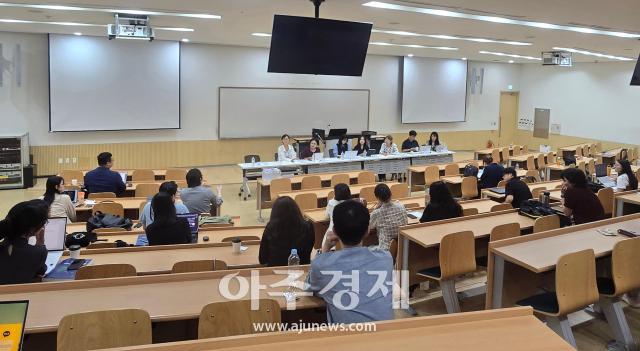
As South Korean universities face a significant decline in the school-age population and financial crises, the policies for attracting international students are creating vastly different ecosystems depending on the type of institution. Experts are urging the government to move away from uniform regulations and adopt differentiated higher education and immigration policies that reflect the unique characteristics of each academic discipline.
In particular, there is a pressing need to enhance monitoring to prevent a decline in educational quality at colleges and local private universities that are hastily recruiting international students to address short-term financial deficits. Additionally, there is a call for the urgent integration of vocational skills and employment visas linked to industry demand for colleges.
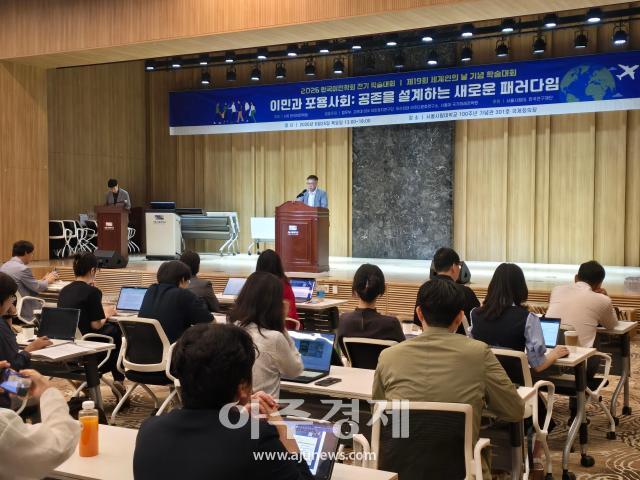
The Korean Immigration Association, led by President Lee Byung-ha, a professor at the University of Seoul, held a conference on June 25 at 1 p.m. at the university's 100th Anniversary Hall. This event, co-organized with the Busan University of Foreign Studies' Institute for Migration and Multicultural Studies to commemorate the 19th World Citizens' Day, featured a session that deeply examined the strategies for attracting international students, which have become a survival issue for universities, drawing the attention of education and immigration law stakeholders.
In particular, there is a pressing need to enhance monitoring to prevent a decline in educational quality at colleges and local private universities that are hastily recruiting international students to address short-term financial deficits. Additionally, there is a call for the urgent integration of vocational skills and employment visas linked to industry demand for colleges.
The Korean Immigration Association, led by President Lee Byung-ha, a professor at the University of Seoul, held a conference on June 25 at 1 p.m. at the university's 100th Anniversary Hall. This event, co-organized with the Busan University of Foreign Studies' Institute for Migration and Multicultural Studies to commemorate the 19th World Citizens' Day, featured a session that deeply examined the strategies for attracting international students, which have become a survival issue for universities, drawing the attention of education and immigration law stakeholders.
Four Adaptation Paths Emerge Based on University Resources: 'Concerns Over Declining Quality with Resource Scarcity'
In the first session on the topic of 'Differentiated Strategies for Attracting International Students to Korean Universities,' Senior Researcher Choi Seo-ri from the Immigration Policy Research Institute analyzed that the influx of international students has grown 2.9 times compared to the previous year, with four-year universities increasing by 2.6 times and colleges experiencing an 11.3-fold surge. She noted a diversification in the student demographic, with a reduced reliance on China and a rise in students from Vietnam.
Based on in-depth interviews with 12 universities, including four-year national universities in the metropolitan area, four-year private universities in local areas, and colleges, Choi classified the types of international student recruitment into four categories:
Specifically, ▲ metropolitan four-year universities select students based on the same criteria as Korean students and have the financial and evaluative resources to maintain a 'resource-preserving' model; ▲ local four-year national universities focus on meeting government evaluation indicators, termed 'resource-fulfilling'; ▲ local private universities, which lack both students and financial resources, rely on an 'survival' model that depends on dedicated tracks for international students; and ▲ colleges, facing the greatest difficulty in student recruitment but willing to make bold academic reforms, adopt a 'job-visa integrated' model that links employment and visas after graduation.
Choi emphasized that institutions with severe resource shortages (local private universities and colleges) tend to have academic standards that are subordinate to resource acquisition logic, stating, 'Even within flexible strategies, universities must rigorously manage the quality of education.'
Based on in-depth interviews with 12 universities, including four-year national universities in the metropolitan area, four-year private universities in local areas, and colleges, Choi classified the types of international student recruitment into four categories:
Specifically, ▲ metropolitan four-year universities select students based on the same criteria as Korean students and have the financial and evaluative resources to maintain a 'resource-preserving' model; ▲ local four-year national universities focus on meeting government evaluation indicators, termed 'resource-fulfilling'; ▲ local private universities, which lack both students and financial resources, rely on an 'survival' model that depends on dedicated tracks for international students; and ▲ colleges, facing the greatest difficulty in student recruitment but willing to make bold academic reforms, adopt a 'job-visa integrated' model that links employment and visas after graduation.
Choi emphasized that institutions with severe resource shortages (local private universities and colleges) tend to have academic standards that are subordinate to resource acquisition logic, stating, 'Even within flexible strategies, universities must rigorously manage the quality of education.'
Differences in International Student Strategies Evidenced by Data: Four-Year Universities Focus on 'Structural Portfolio,' Colleges on 'Immediate Deficit Coverage'
Yang Yoon-joo, a researcher at Sungkyunkwan University's Graduate School of Public Administration, presented on the topic of 'Differences in Financial Structures and International Student Recruitment Strategies by Academic Discipline.' Yang demonstrated through quantitative data from the Korea Foundation for the Advancement of Science and Creativity's budget reports (2015-2023) that the purposes of attracting international students differ fundamentally between four-year universities and colleges.
According to Yang's analysis, the recruitment of international students at private four-year universities is characterized more by a 'structural portfolio' strategy aimed at diversifying revenue sources rather than merely covering immediate deficits. In contrast, the recruitment of international students at colleges is functioning as a 'marginal immediate response measure' to urgently address budget shortfalls.
Yang stressed, 'Given that the mechanisms for attracting students differ significantly by academic discipline, future higher education and immigration policies must also be differentiated.'
According to Yang's analysis, the recruitment of international students at private four-year universities is characterized more by a 'structural portfolio' strategy aimed at diversifying revenue sources rather than merely covering immediate deficits. In contrast, the recruitment of international students at colleges is functioning as a 'marginal immediate response measure' to urgently address budget shortfalls.
Yang stressed, 'Given that the mechanisms for attracting students differ significantly by academic discipline, future higher education and immigration policies must also be differentiated.'
Experts Suggest Universities Focus on 'Internationalization Certification Evaluation' Over Visa Barriers
Experts at the event highlighted the need for advanced institutional designs that consider the stabilization phase after attracting international students. They pointed out that improvements to the visa system by the Ministry of Justice, as well as fundamental reforms to the university evaluation system by the Ministry of Education, are essential.
To prevent colleges with weak overseas networks from hastily recruiting international students without ensuring their future career paths or job placements, there is a call for evaluation metrics to be improved from the ground up.
Yoo Min, head of the Policy Research Division at the Immigration Policy Research Institute, also emphasized that establishing a clear purpose and direction for international student policies is the government's top priority. Yoo noted, 'While the government has made some adjustments to simple metrics in the recent Education Internationalization Capacity Certification Evaluation (4th cycle) considering the realities of colleges, it is still difficult to view this as a fundamentally 'two-track' approach.'
Yoo further stated, 'For the international student policies at colleges to be effective, the government must first set a clear goal of whether to cultivate them as 'regional resident talents.' Since the core objective is to bring in international students and place them in specific job sectors, the evaluation system must be boldly supplemented to fully respond to these on-the-ground realities.'
To prevent colleges with weak overseas networks from hastily recruiting international students without ensuring their future career paths or job placements, there is a call for evaluation metrics to be improved from the ground up.
Yoo Min, head of the Policy Research Division at the Immigration Policy Research Institute, also emphasized that establishing a clear purpose and direction for international student policies is the government's top priority. Yoo noted, 'While the government has made some adjustments to simple metrics in the recent Education Internationalization Capacity Certification Evaluation (4th cycle) considering the realities of colleges, it is still difficult to view this as a fundamentally 'two-track' approach.'
Yoo further stated, 'For the international student policies at colleges to be effective, the government must first set a clear goal of whether to cultivate them as 'regional resident talents.' Since the core objective is to bring in international students and place them in specific job sectors, the evaluation system must be boldly supplemented to fully respond to these on-the-ground realities.'
* This article has been translated by AI.
Copyright ⓒ Aju Press All rights reserved.