

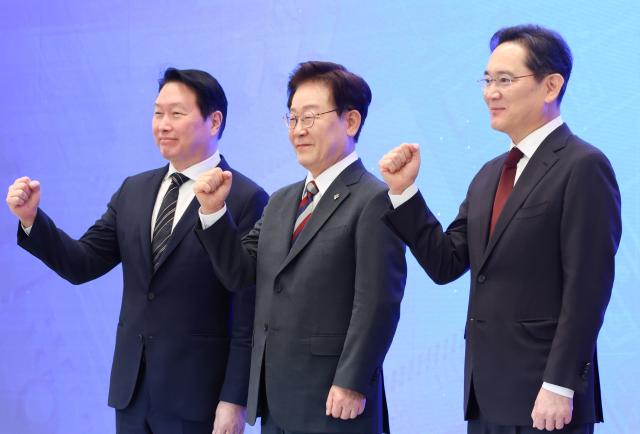
President Lee Jae-myung (center) poses for a photo with Samsung Electronics Chairman Lee Jae-yong (right) and SK Group Chairman Chey Tae-won during the National Report on Three Major Mega Projects at the Blue House. [Photo=Yonhap News]
On June 29, the government announced plans for a semiconductor production facility in Honam during the "National Report on Three Major Mega Projects." This announcement has sparked strong criticism from opposition parties, who argue that the decision on where to establish the semiconductor plant should be made by companies, not the government. In contrast, the Democratic Party claims that the investment announcement reflects the growth potential and policy credibility gradually established by the Lee Jae-myung administration, dismissing the criticism as a political attack.
Jeong Jeong-sik, the floor leader of the People Power Party, raised concerns during a Supreme Council meeting at the National Assembly, questioning the transparency, fairness, and objectivity of the process surrounding the establishment of the semiconductor cluster in Gwangju and Jeonnam. He criticized President Lee's earlier comments suggesting that the investment was guided by "administrative direction," implying that the plant's location was determined by government interference.
At a meeting of the Reform Party's Supreme Council, leader Lee Jun-seok likened the investment announcement to "writing a prescription before diagnosing a disease," stating that the prescription was predetermined to be in Honam, while the diagnosis keeps changing. He warned that if companies do not follow this prescribed path, they might be labeled as reactionaries, despite the government calling it a "business choice."
Additionally, lawmakers and local government officials from regions such as Daegu, Gyeongbuk, and Chungcheong held press conferences, emphasizing the need for a fair competition to attract semiconductor plants.
Choi Eun-seok, the chief spokesperson for the People Power Party, commented after the national report, stating, "There was no explanation of why it must be in Honam or what verification and procedures were followed. The presentation was flashy, but the content was empty." He criticized the event as a political show hastily organized to cover the Democratic Party's internal issues rather than a genuine presentation of the national strategy for the industry.
In contrast, the Democratic Party praised the investment plan as a "national strategy" that will redraw South Korea's industrial map. Democratic lawmakers from Gwangju and Jeonnam emphasized that the investment was made based on corporate decisions and should not become a point of political contention.
Han Byeong-do, the floor leader of the Democratic Party, noted, "The harsh reality is that global markets, including Europe, cannot sell products unless they meet RE100 requirements. Choosing optimal locations with renewable energy infrastructure and ample water resources is a survival strategy." He criticized the People Power Party for invoking outdated regionalism and using inflammatory language like "corporate twisting" to distort the facts, urging them to stop baseless agitation and seek cross-party cooperation.
Supreme Council member Hwang Myeong-seon stated, "The investments by Samsung Electronics and SK Hynix are strategic decisions made for economic analysis and market logic," and called for an end to using growth strategies aimed at promoting national balanced development as tools for political attacks that divide regions.
Meanwhile, the government announced its plan to establish the Honam region as a second semiconductor production base, with a total investment of 800 trillion won and the construction of four memory semiconductor production facilities.
* This article has been translated by AI.
Jeong Jeong-sik, the floor leader of the People Power Party, raised concerns during a Supreme Council meeting at the National Assembly, questioning the transparency, fairness, and objectivity of the process surrounding the establishment of the semiconductor cluster in Gwangju and Jeonnam. He criticized President Lee's earlier comments suggesting that the investment was guided by "administrative direction," implying that the plant's location was determined by government interference.
At a meeting of the Reform Party's Supreme Council, leader Lee Jun-seok likened the investment announcement to "writing a prescription before diagnosing a disease," stating that the prescription was predetermined to be in Honam, while the diagnosis keeps changing. He warned that if companies do not follow this prescribed path, they might be labeled as reactionaries, despite the government calling it a "business choice."
Additionally, lawmakers and local government officials from regions such as Daegu, Gyeongbuk, and Chungcheong held press conferences, emphasizing the need for a fair competition to attract semiconductor plants.
Choi Eun-seok, the chief spokesperson for the People Power Party, commented after the national report, stating, "There was no explanation of why it must be in Honam or what verification and procedures were followed. The presentation was flashy, but the content was empty." He criticized the event as a political show hastily organized to cover the Democratic Party's internal issues rather than a genuine presentation of the national strategy for the industry.
In contrast, the Democratic Party praised the investment plan as a "national strategy" that will redraw South Korea's industrial map. Democratic lawmakers from Gwangju and Jeonnam emphasized that the investment was made based on corporate decisions and should not become a point of political contention.
Han Byeong-do, the floor leader of the Democratic Party, noted, "The harsh reality is that global markets, including Europe, cannot sell products unless they meet RE100 requirements. Choosing optimal locations with renewable energy infrastructure and ample water resources is a survival strategy." He criticized the People Power Party for invoking outdated regionalism and using inflammatory language like "corporate twisting" to distort the facts, urging them to stop baseless agitation and seek cross-party cooperation.
Supreme Council member Hwang Myeong-seon stated, "The investments by Samsung Electronics and SK Hynix are strategic decisions made for economic analysis and market logic," and called for an end to using growth strategies aimed at promoting national balanced development as tools for political attacks that divide regions.
Meanwhile, the government announced its plan to establish the Honam region as a second semiconductor production base, with a total investment of 800 trillion won and the construction of four memory semiconductor production facilities.
* This article has been translated by AI.
Copyright ⓒ Aju Press All rights reserved.