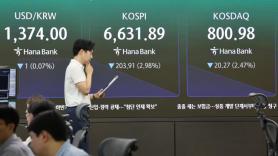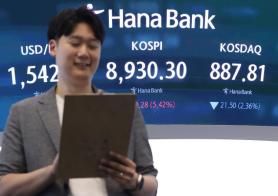
The KOSPI closed at 6,977.94, up 164.60 points, or 2.42 percent, ending the week 11.5 percent higher and edging back toward the 7,000 level it surrendered a month ago on July 13. Foreign investors bought a net 3.04 trillion won ($2.14 billion), while domestic individuals and institutions sold into the rally.
The rebound has come on relatively thin trading. The index remains about 26 percent below the record intraday high of 9,385.59 reached in June, before a July collapse that left the KOSPI down 22.19 percent for the month, its steepest monthly loss since the 2008 global financial crisis.
Samsung Electronics and SK hynix also remain well below their June highs despite Friday's gains.
KOSPI turnover totaled 26.73 trillion won Friday, less than 40 percent of the 67.26 trillion won traded during the June peak when the index was above 9,000.
Individuals sold a net 1.98 trillion won and institutions 1.06 trillion won, leaving foreigners as the clear buyers.
That split has characterized much of the August recovery. Retail investors, badly hit by July's leverage unwind, have continued selling into the rebound rather than following foreign money back into the market.
Telecom led the sector gains, rising 8.5 percent as SK Telecom jumped 10.5 percent to 100,500 won. The company gave no confirmed reason for the move.
Autos followed with a 6.2 percent gain. Hyundai Motor surged 8.2 percent to 453,000 won, a day after its Genesis luxury brand unveiled a next-generation hybrid system and said the GV80 Hybrid would launch next month.
The chipmakers advanced without dominating the market. Samsung Electronics gained 2.4 percent to 274,500 won. SK hynix rose 3.3 percent to 1,645,000 won, still well below levels reached during its June surge.
Refiners also attracted buying, with oil and gas shares up 5.8 percent.
The session was far from one-directional. The KOSPI opened at 6,995.67 and briefly cleared 7,000 to reach 7,010.86 before falling as low as 6,848.43 as investors took profits. It recovered into the close.
Softer-than-expected U.S. producer-price data released overnight supported the opening advance. The U.S. producer price index was unchanged in July from June, below market expectations for a 0.2 percent increase, while its annual increase slowed to 4.7 percent from 5.5 percent.
The KOSDAQ, the secondary market dominated by smaller and technology companies, closed at 864.65, up 3.28 points, or 0.4 percent, after spending much of the session below Thursday's close.
Foreign investors were net sellers there, underscoring the junior market's weaker participation in the broader August rebound.
Elsewhere in the region, Tokyo's Nikkei 225 gained about 0.6 percent, while the Shanghai Composite was little changed.
The won traded at 1,419.10 per dollar, slightly stronger than Thursday.
- Foreigners remained the engine of the KOSPI rebound, buying a net 3.04 trillion won Friday as domestic retail and institutional investors sold.
- Market leadership broadened beyond semiconductors, with telecom and autos outperforming Samsung Electronics and SK hynix.
- The recovery remains fragile beneath the headline gain: the KOSPI is still about 26 percent below its June record and Friday turnover was less than 40 percent of the June peak.
Foreign money kept buying Seoul for a fifth straight session on Friday, and this time the leadership came from telecom and automakers rather than the two chipmakers that both built and broke this market.
The KOSPI closed at 6,977.94, up 164.60 points or 2.42 percent, ending week 11 percent higher and edging toward the 7,000 market it surrendered a month ago on July 13. Foreign investors bought a net 3.04 trillion won ($2.14 billion) while domestic individuals and institutions sold into them.
The rebound has been modest in thin trade. The index remains roughly 26 percent below the record 9,385.59 it reached in June, before a July collapse that ranks as the worst month in the market's history, and Samsung Electronics and SK hynix are both far from their June highs even after Friday's gains.
Trade turnover nearly halved to 26.73 trillion won Friday from 67.26 trillion won during the June peak when the key index traded above 9,000 mark.
Individuals sold a net 1.98 trillion won ($1.40 billion) and institutions a net 1.03 trillion won ($724 million).
That split has been the shape of the entire August recovery. Retail money that was forced out during July's margin unwind is not coming back into the bounce.
Wireless telecom led all sectors, up 8.5 percent, on a 10.5 percent jump in SK telecom to 100,500 won ($70.82). The company gave no confirmed reason for the move.
Autos followed, up 6.2 percent. Hyundai Motor rose 8.2 percent to 453,000 won ($319.22), a gain local brokerages read as positioning ahead of the Genesis GV80 hybrid, whose launch plan the group disclosed on Thursday.
The chipmakers advanced without leading. Samsung Electronics gained 2.4 percent to 274,500 won ($193.44). SK hynix rose 3.3 percent to 1,645,000 won ($1,159.19), still around 37 percent below the level it first passed in June.
Refiners also drew buying, with oil and gas up 5.8 percent.
The session was not one-directional. The index opened above 6,995, briefly cleared 7,010, then fell as low as 6,848 as institutions took profits, before recovering into the close.
Softer than expected U.S. producer price data for July, released overnight, supported the open.
The KOSDAQ, the secondary market for smaller and technology companies, closed at 864.65, up 3.28 points or 0.4 percent, after spending much of the session below Thursday's close. Foreign investors were net sellers there, and the junior market has lagged the whole rebound.
Elsewhere in the region, the Nikkei 225 in Tokyo closed at 68,713.80, up 0.6 percent, with Kioxia up 3.8 percent, SoftBank Group up 2.9 percent and Advantest up 2.6 percent. The composite index in Shanghai was little changed.
The won traded at 1,419.10 per dollar, slightly stronger than Thursday.
Copyright ⓒ Aju Press All rights reserved.