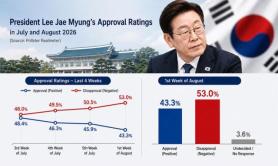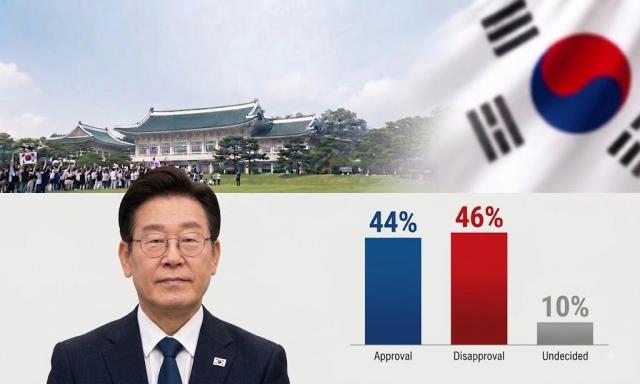
Pollster Gallup Korea conducted a poll of about 1,000 adults nationwide earlier this week and found that his disapproval rating rose eight percentage points from the previous poll in the fourth week of last month to 46 percent, the highest since his inauguration in June last year.
His dwindling approval rating, in contrast, further slid to 44 percent, down seven points from 51 percent during the same period, dropping below 50 percent for the first time.
Some 10 percent remained undecided or refused to give an answer.
His predecessor Yoon Suk Yeol's disapproval rating outpaced his approval rating for the first time in July 2022, just two months after taking office and even before his honeymoon period ended, in a phenomenon known as a "dead cross," while other predecessors like Moon Jae-in and Park Geun-hye saw it happen about a year into their terms and hardly recovered afterward.
By region, Lee's approval rating fell below 50 percent in all areas except his support base of southwestern Jeolla provinces including Gwangju, where it stood at 71 percent. The rating was 42 percent in Seoul, Incheon and Gyeonggi, and 41 percent in Busan, Ulsan and South Gyeongsang Province, while it was 35 percent in the conservative stronghold of Daegu and North Gyeongsang Province.
By age, Lee maintained majority support among those in their 40s at 58 percent and 50s at 56 percent. In contrast, his approval rating stood at around 30 percent among those aged 18-29.
Among those who approved of Lee's performance, diplomacy was the most cited reason at 19 percent, while real estate-related policies topped the list among those who disapproved at 30 percent.
That appears to reflect mounting discontent with the government's recent revisions to housing and tax policies, under which married couples who jointly own a home could be treated as multiple-home owners and face higher taxes. Long-term homeowners could also lose some tax benefits, among other changes.
Meanwhile, Cheong Wa Dae said the public appears to favor constitutional reform allowing a four-year presidential term with the option of one additional term, along with giving the National Assembly more power to check the presidency and maintain a balance of power. It said the current single, five-year presidential system could lead to an "imperial presidency" and stressed that the National Assembly should take the lead in discussions on any constitutional amendment.
The remarks came after lawmaker Kim Tae-ho of the main opposition People Power Party said Lee had suggested during a private golf gathering last month that he could pursue constitutional reform even if it meant shortening his term.
AJP Takeaways:
- Lee Jae Myung's disapproval rating surpassed his approval rating for the first time since he took office in June 2025, according to a Gallup Korea poll released Aug. 14, 2026.
- Lee's disapproval rating rose to 46 percent, up eight percentage points from the previous poll, while his approval rating fell seven points to 44 percent.
- Real estate and tax policies were the leading reason for dissatisfaction, cited by 30 percent of respondents who disapproved of Lee’s performance, amid criticism of recent housing and tax policy revisions.
- Lee's approval rating fell below 50 percent in most regions, with the exception of Gwangju and the southwestern Jeolla provinces at 71 percent. Support was highest among people in their 40s and 50s.
- Cheong Wa Dae said it favors constitutional reform to introduce a four-year presidential term with the option of one additional term and strengthen the National Assembly's role in checking presidential power.
Copyright ⓒ Aju Press All rights reserved.