

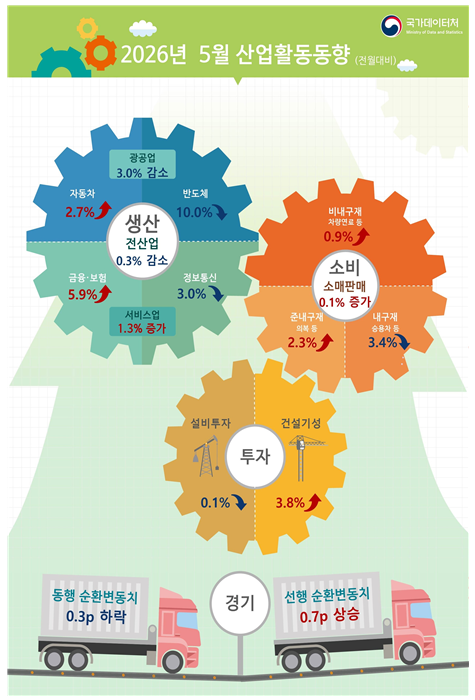
Industrial production across all sectors fell last month due to weak mining and manufacturing, with facility investment also declining. Despite a boost in semiconductor exports, the sector's performance did not significantly impact overall industrial activity. However, retail sales saw a slight increase due to higher demand for vehicle fuel and cosmetics.
According to the National Data Agency's report released on June 30, 2026, total industrial production decreased by 0.3% in May compared to the previous month. While the service sector grew by 1.3%, the mining and manufacturing sector's production fell by 3.0% due to declines in semiconductors and pharmaceuticals.
Mining and manufacturing output saw increases in areas such as automotive production (2.7%), but significant drops in semiconductors (-10.0%) and pharmaceuticals (-17.5%) pulled overall production down. This decline is attributed to reduced output of memory semiconductors, including flash memory and DRAM. Additionally, disruptions in raw material supply due to the ongoing Middle East conflict and fires at automotive parts suppliers contributed to the negative impact.
Conversely, the service sector's production rose by 1.3%, driven by increases in finance and insurance (5.9%) and professional, scientific, and technical services (9.3%). Lee Doo-won, a statistical officer at the National Data Agency, noted, "The increase in production in finance and insurance, as well as in research and development, appears to be linked to rising bank loans and increased trading volumes in the stock market."
The retail sales index increased by 0.1% compared to April. While sales of durable goods, such as automobiles, fell by 3.4%, sales of non-durable goods (0.9%) and semi-durable goods (2.3%) rose, leading to an overall positive shift. The agency attributed the increase in clothing sales, particularly summer apparel, and the rise in cosmetics sales to an influx of foreign tourists.
Facility investment continued to show weakness, declining by 0.1% from the previous month. Investment in transportation equipment, particularly automobiles, increased by 0.2%, but investment in machinery, including precision instruments, fell by 0.2%.
Construction output increased by 3.8% month-on-month, with both building (5.1%) and civil engineering (0.2%) projects showing growth.
The coincident index, which reflects current economic trends, fell by 0.3 points compared to the previous month, despite increases in service sector production and import volumes. This marks the largest drop since October of last year, when it fell by 0.4 points.
Looking ahead, the leading index, which forecasts future economic trends, rose by 0.7 points from the previous month, driven by increases in the KOSPI and export-import price ratios.
The government anticipates improvements in industrial activity indicators as external uncertainties, such as the signing of a memorandum of understanding for peace between the U.S. and Iran, ease. However, officials acknowledge that the recovery of the domestic economy is slow, and they plan to intensify efforts to stabilize prices.
A spokesperson from the Ministry of Economy and Finance stated, "Challenges persist for households due to high inflation, high exchange rates, high interest rates, and sluggish employment. The government will focus on stabilizing living costs, supporting employment in vulnerable sectors such as youth, and assisting small businesses affected by high exchange rates and struggling borrowers."
* This article has been translated by AI.
Copyright ⓒ Aju Press All rights reserved.