

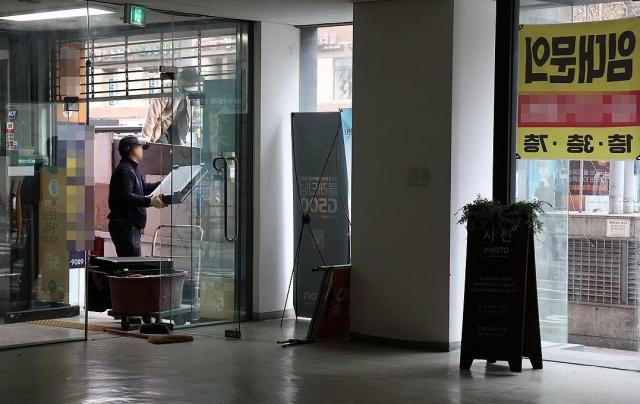
In the second half of this year, the financial burden of repaying policy loans for bankrupt small business owners is expected to decrease. A new credit evaluation system tailored for small businesses and an artificial intelligence (AI) assistant service will be introduced, and energy costs such as electricity and gas will be included in the payment linkage system aimed at improving the transaction environment for small and medium-sized enterprises (SMEs).
According to the Ministry of Finance and Economy, the repayment support for policy loans aimed at helping bankrupt small business owners will begin in July.
The support will target individuals who received direct loans from small business policy funds from 2023 until now and have become unemployed after closing their businesses in 2025 or later. Those who secure employment after closing their businesses will be able to extend the repayment period of their direct loans for up to seven years.
If they maintain employment for over a year, they will also receive a 0.5 percentage point reduction in the interest rate on their remaining loan balance. Previously, bankrupt small business owners were excluded from repayment extensions and interest rate reductions, but support will now be available based on employment and tenure.
A specialized credit evaluation system for small businesses will also be introduced. Previously, loan assessments focused primarily on the financial history and credit ratings of business owners, which disadvantaged those with limited financial records.
The new credit evaluation system will assess the future growth potential of small businesses using non-financial information such as sales, industry type, number of employees, business longevity, and platform growth index. Small businesses with high growth potential will benefit from improved credit ratings, increased loan limits, and preferential interest rates.
This system will be piloted in August at several banks, including Industrial Bank of Korea, Shinhan Bank, Kookmin Bank, NongHyup Bank, Woori Bank, Hana Bank, and Jeju Bank, with potential for future expansion.
Additionally, an AI assistant service for small businesses will be launched in the second half of the year. Previously, small business owners and prospective entrepreneurs had to search multiple agency websites for information on support policies, market conditions, legal matters, and statistics. Now, they will be able to access this information in a question-and-answer format through the AI assistant.
The AI assistant will provide comprehensive information on policies, market conditions, statistics, and legal matters, linking users to application sites for relevant support policies. The government expects this will enhance the accessibility and convenience of policy information for small business owners.
Measures to improve the transaction environment for SMEs will also be implemented. The payment linkage system will now include energy costs in addition to the major raw materials previously covered.
The current system applies primarily to major raw materials that account for more than 10% of the payment amount, leaving companies with significant energy costs, such as electricity and gas, excluded from the benefits. Going forward, transactions involving energy costs will also be included in the payment linkage system.
As a result, SMEs that are subcontracted will be able to adjust their payment amounts based on a pre-agreed linkage formula if energy costs fluctuate. This creates a structure where the burden of rising energy prices is shared between the primary contractor and subcontractors.
The government will also revise the Onnuri gift certificate system, strengthening regulations against fraudulent distribution and refining the criteria for participation. The aim is to enhance transparency in support systems for traditional markets and shopping districts, ensuring that policy benefits reach small business owners effectively.
The government anticipates that these changes will alleviate the financial burdens of small business owners preparing for a comeback after closure and improve access to policies for micro-enterprises. Additionally, the expansion of the payment linkage system is expected to enhance the operational stability of SMEs vulnerable to fluctuations in energy prices.
* This article has been translated by AI.
Copyright ⓒ Aju Press All rights reserved.