

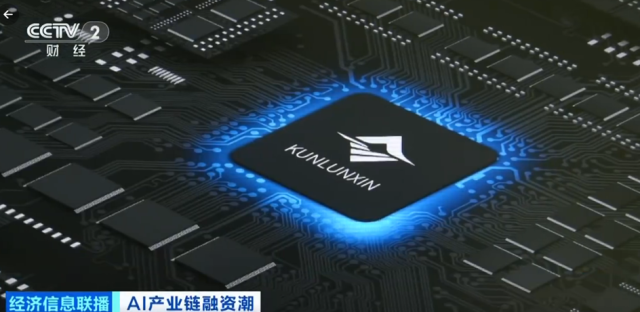
Baidu's AI semiconductor subsidiary Kunlunxin is pursuing an initial public offering (IPO) on the Hong Kong Stock Exchange, requiring investors to commit to purchasing large quantities of its AI chips. This strategy is seen as a way to secure funding while also attracting customers amid increasing competition in China's AI chip market.
According to the U.S. tech publication The Information, Kunlunxin has set a condition for cornerstone investors to purchase AI chips worth three to seven times their subscription amount. For instance, an investor participating in a $100 million IPO would be obligated to buy between $300 million and $700 million (approximately 1 trillion won) worth of Kunlunxin AI chips.
Typically, cornerstone investors are expected to link product purchases to about 50% to 100% of their subscription amount. However, Kunlunxin's requirement for purchases up to seven times the investment is interpreted as a strategy to attract industrial investors who will actually use the AI chips, rather than just financial investors. This move aims to secure long-term customers in a fiercely competitive market.
Recently recognized as an alternative to Nvidia in China, Kunlunxin supplies AI chips to major tech companies, including its parent company Baidu, Tencent, and Pinduoduo, as well as state-owned enterprises, banks, and telecommunications companies. Reports indicate that it has received over 320,000 orders, with most production capacity already booked through the end of the year.
Despite the backlog of orders, the requirement for large chip purchases as a condition for the IPO reflects a strategy focused on securing long-term customers rather than immediate revenue growth, according to industry analysts.
The market has high expectations for Kunlunxin's valuation, targeting approximately $50 billion (about 77 trillion won), which exceeds Baidu's current market capitalization of around $36 billion.
However, concerns have been raised that without explosive revenue growth to support such a high valuation, Kunlunxin's market value could quickly adjust post-IPO. Additionally, competition with other Chinese AI chip companies, including Huawei, Alibaba, Cambrian, Moore Threads, and Mushi, is intensifying.
There are also uncertainties regarding entry into the public sector. According to the Chinese electronics media outlet EET China, the China Information Security Evaluation Center and the National Secret Protection Technology Evaluation Center included AI learning and inference chips in their first-grade (Level 1) certification list in May. While nine products from seven companies, including Huawei and Alibaba, were selected, Kunlunxin's products did not make the list.
EET China noted that this certification could likely serve as a purchasing criterion for government and state-owned enterprises, potentially posing challenges for Kunlunxin's expansion into the public and state-owned enterprise markets.
Founded in 2012 as an AI semiconductor division under Baidu, Kunlunxin quickly entered the AI accelerator development space in China. After spinning off from Baidu in 2021, it shifted its focus from internal AI chip demand to securing external customers, including state-owned enterprises and local government data centers, generating over half of its revenue from external sales last year.
Nomura Securities estimates that Kunlunxin's revenue for this year will reach approximately 6.6 billion yuan, significantly surpassing the previous forecast of 5.4 billion yuan.
* This article has been translated by AI.
Copyright ⓒ Aju Press All rights reserved.