

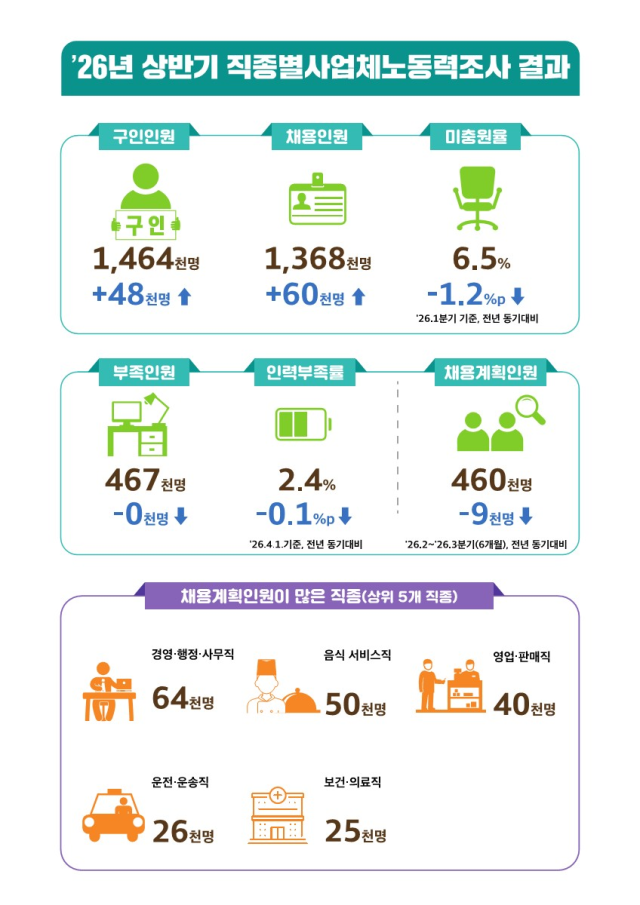
According to the Ministry of Employment and Labor's "2026 Job Vacancy Survey" released on June 30, the number of job openings at businesses with at least one employee reached 1,464,000 in the first quarter, an increase of 48,000 (3.4%) from the same period last year. Actual hires also rose to 1,368,000, up by 60,000 (4.6%).
Despite the increase in job openings and hires, the number of unfilled positions stood at 96,000, a decrease of 13,000 (11.8%) from the previous year. This marks the first time since the expansion of statistical coverage in 2021 that unfilled positions have fallen below 100,000. The unfilled position rate also dropped from 7.7% last year to 6.5% this year, the lowest level recorded during this period.
Jung Hyang-sook, head of the Labor Market Research Division at the Ministry, explained, "An unfilled position rate of 6.5% means that out of 100 job openings, 6.5 positions were not filled, which is the lowest level since 2021."
By industry, the health and social welfare services sector saw the largest increase in job openings, with 26,000 more than the previous year, followed by construction (12,000) and business facility management, support, and rental services (6,000).
In contrast, the retail and wholesale sector experienced the largest decline, with 9,000 fewer job openings and 7,000 fewer hires. The Ministry attributed this decrease to recent economic conditions.
In terms of job categories, the food service sector had the highest number of job openings (171,000) and hires (164,000). The care services sector also saw significant increases, with job openings rising by 23,000 and hires by 21,000. However, the sales and marketing sector experienced the largest declines, with job openings down by 18,000 and hires down by 16,000.
Hiring demand increased across all business sizes. Companies with fewer than 300 employees reported 1,246,000 job openings and 1,164,000 hires, reflecting increases of 43,000 (3.6%) and 53,000 (4.8%), respectively. Larger companies with 300 or more employees reported 217,000 job openings, an increase of 5,000 (2.3%), and 204,000 hires, up by 8,000 (3.8%).
However, labor shortages persist across various sectors. The industries with the highest number of unfilled positions were manufacturing, health and social welfare services, and retail and wholesale. Notably, the manufacturing sector had the highest unfilled position rate at 16.2%, indicating that more than 16 out of every 100 job openings went unfilled. Specific manufacturing roles, such as metal materials installation, maintenance, and production, as well as chemical and environmental installation, maintenance, and production, also showed high unfilled position rates.
The primary reason companies struggle to fill positions is the lack of qualified applicants with the necessary experience. Among the reasons for unfilled positions, 25.8% cited a lack of applicants with the required experience, followed by 18.5% for a lack of applicants with the necessary education or qualifications, and 18.1% for wages and working conditions not meeting job seekers' expectations.
As of April this year, the projected shortage of workers stood at 467,000, maintaining a similar level to last year, although the labor shortage rate slightly decreased to 2.4%. The hiring plans for the second and third quarters of this year are projected at 460,000, a decrease of 9,000 compared to the previous year.
* This article has been translated by AI.
Copyright ⓒ Aju Press All rights reserved.