
The climate crisis and the AI revolution represent two of the most significant changes humanity faces today. One is a matter of survival, while the other pertains to technology. However, these two changes are now interconnected. AI is becoming the most powerful technology for addressing the climate crisis, while the climate crisis is emerging as a new growth driver for the AI industry.
Minister of Climate, Energy and Environment Kim Sung-hwan defines this era of change as the 'Climate, Energy, and Environment AI Transition (AX).' He envisions utilizing AI to establish a renewable energy-centered power grid while simultaneously advancing carbon neutrality, responding to climate disasters, and innovating the environmental industry.
His strategy aims to accelerate the transition to a green civilization (GX) through AI, positioning South Korea as a leader in both AI and green industries.
The question is clear.
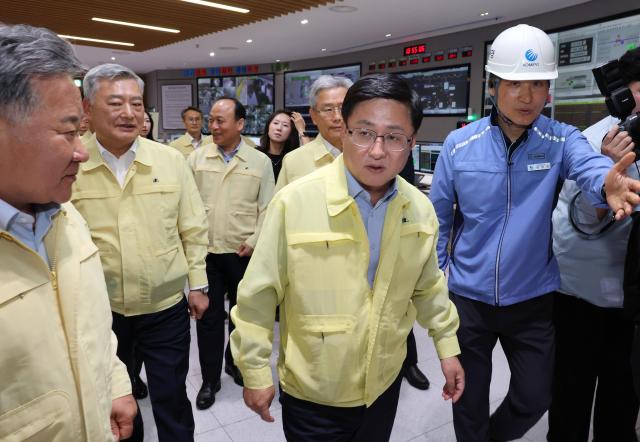
Can South Korea turn the climate crisis into a new growth opportunity through AI?
AI as a Solution to the Climate Crisis
Minister Kim views AI not merely as a digital technology but as a core infrastructure for responding to the climate crisis.
"We are currently facing a global challenge of climate crisis alongside a technological inflection point represented by AI," he stated, outlining a direction to strategically integrate AI into climate, energy, and environmental policies.
He emphasized that the Ministry is pursuing a comprehensive AI transition (AX) in line with the government's strategy to become one of the top three AI nations.
AI is no longer just an auxiliary tool for environmental policy; it has become a key technology that determines national competitiveness.
AI-Powered Energy Networks Lead the Energy Transition
In the AI era, power must also be intelligent.
Minister Kim identified the expansion of renewable energy and the establishment of AI-based intelligent power grids as core tasks.
AI can predict solar and wind energy generation and analyze power demand in real-time to optimize supply.
As the share of renewable energy increases, AI-based power management becomes even more crucial. He stated that he aims to promote an energy transition centered on renewable energy to secure energy security, carbon neutrality, and competitiveness in advanced industries.
The key to the energy revolution is not the power plants but the AI-operated power grid.
AI in the Environmental Industry as a New Growth Driver
Minister Kim is also pursuing a strategy to develop the environmental industry into an AI industry.
The Ministry of Climate, Energy and Environment is focusing on nurturing AI-based products and services in five areas: carbon neutrality, water management, resource circulation, environmental safety, and weather and climate, through the 'Rapid Commercialization Support Project for AI Application Products.'
From 2026 to 2027, the government plans to make significant investments in the development of AI application products, and the Ministry is actively supporting the commercialization of AI technologies in the environmental sector.
AI can become a technology that creates new industries rather than just a tool for environmental regulation.
AI Predicts Climate Disasters
Climate change is intensifying natural disasters such as heavy rainfall, heatwaves, and wildfires.
Minister Kim announced plans to utilize AI-based simulations and data analysis to predict climate disasters more accurately and proactively protect public safety.
Environmental management will also transition from a human-centered approach to an AI-based intelligent system to reduce blind spots in management and enhance policy accuracy.
AI is not just a technology for responding to disasters; it is a technology for mitigating damage in advance.
Public Data Fuels AI Innovation
AI cannot advance without data.
The Ministry of Climate, Energy and Environment is hosting an AX idea competition with public institutions to discover AI services and policy ideas utilizing public data in areas such as power, water resources, weather, and the environment.
This initiative goes beyond a simple competition; it aims to open public data and build an ecosystem that connects AI startups and policy innovation.
In the AI era, public data is a new asset that creates national competitiveness.
Green Industries and AI Grow Together
Minister Kim views the climate crisis not as a cost but as an opportunity for industrial innovation.
He believes that the combination of AI, renewable energy, climate technology, and the circular economy can create new markets and jobs.
Carbon neutrality is evolving into a national growth strategy that connects environmental policy with the AI industry and advanced manufacturing.
The green transition can be realized more quickly and efficiently through AI.
Minister Kim's AI strategy connects climate, energy, and the environment.
AI-based power grids, carbon neutrality, environmental industry innovation, and climate disaster response all aim toward a single goal.
That goal is to transform South Korea into a green nation based on AI.
The climate crisis is an unavoidable reality.
However, AI can become a technology that transforms that crisis into a new growth driver.
If South Korea leads in both AI and green transition, it has the potential to become a nation that sets the standard for global green industries, surpassing carbon neutrality.
: Kim Sung-hwan, Minister of Climate, Energy and Environment:Kim Sung-hwan, Minister of Climate, Energy and Environment, has led climate and energy policy after serving as a lawmaker and policy expert. Since taking office, he has directly overseen the Ministry's AI transition (AX), focusing on building AI-based intelligent power grids, predicting climate disasters, commercializing AI application products in the environmental industry, and fostering AI innovation based on public data.
His vision is to combine AI and green transition to position South Korea as a leader in both climate crisis response and green industry.
* This article has been translated by AI.
Copyright ⓒ Aju Press All rights reserved.