
SEOUL, July 02 (AJP) - South Korea's consumer inflation accelerated to a 30-month high in June as soaring petroleum prices accounted for nearly one percentage point of the headline increase, keeping pressure on policymakers while demand remains weak.
The consumer price index stood at 119.99 in June, up 3.2 percent from a year earlier, the Ministry of Data and Statistics said Thursday.
The rate accelerated from 3.1 percent in May and remained above 3 percent for a second straight month. It was the fastest increase since December 2023, when consumer prices also rose 3.2 percent.
From a month earlier, however, the index rose just 0.1 percent, slowing sharply from 0.5 percent increases in both April and May, suggesting the recent inflation surge may be losing momentum on slack demand.
Petroleum prices jumped 24.7 percent from a year earlier, the steepest increase since July 2022.
Gasoline prices rose 23.1 percent, diesel 33.7 percent and kerosene 23.1 percent.
Petroleum products alone added 0.93 percentage point to the headline inflation rate, underscoring the outsized impact of higher fuel costs on June inflation.
Industrial goods prices climbed 4.4 percent from a year earlier, contributing 1.47 percentage points to overall inflation.
Agricultural, livestock and fishery product prices rose 3.2 percent, widening from 2.2 percent in May.
By spending category, transportation prices jumped 11.1 percent from a year earlier, contributing 1.11 percentage points to overall inflation, the largest increase among major expenditure categories.
The living necessities index, which tracks frequently purchased goods, rose 3.4 percent, up from 3.3 percent in May and the highest level since April 2024.
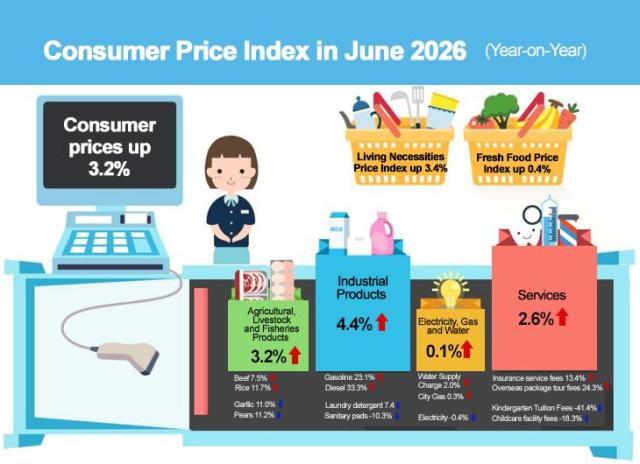
Services prices rose 2.6 percent from a year earlier, slowing from 2.8 percent in May. Personal services increased 3.4 percent, while dining-out prices rose 2.6 percent.
The moderation in service-sector inflation suggested sluggish domestic demand continued to offset part of the imported inflationary pressure from higher energy costs.
According to disclosures by South Korea's five largest commercial banks, non-performing loans to the service sector rose to 1.22 trillion won in the first quarter, surpassing manufacturing and real estate for the first time.
The deterioration reflects mounting financial strain on consumer-facing businesses such as private academies, publishers, video production firms, auto repair shops, medical clinics and nursing homes, where softer household spending has eroded sales and debt-servicing capacity.
Deputy Governor Lee Ji-ho said June inflation edged higher because petroleum prices remained elevated and agricultural product prices accelerated, even as travel-related service prices cooled from May.
The combination suggests inflation is being driven primarily by supply-side energy costs rather than broad-based domestic demand.
The central bank said inflation is expected to ease somewhat in July as global oil prices decline and government price-stabilization measures take effect.
However, it warned that consumer inflation is likely to remain elevated for some time as the impact of the Gulf crisis continues to filter through energy prices with a time lag.
The BOK also said core inflation is expected to remain elevated as higher production costs gradually pass through to consumers, adding that it would continue to monitor price developments closely.
Separately, the government is preparing measures aimed at keeping annual inflation below 3 percent in the second half.
It plans to present an inflation forecast of 2.7 percent to 2.9 percent in its second-half economic policy package, signaling its determination to prevent annual inflation from exceeding 3 percent despite seasonal price volatility.
First Vice Minister of Economy and Finance Lee Hyoung-il said at a vice-ministerial price meeting that June inflation would have reached an estimated 3.6 percent without the temporary ceiling on petroleum prices.
He said the measure lowered headline inflation by 0.4 percentage point and called on ministries to swiftly implement additional measures to stabilize prices of daily necessities. The government plans to focus on petroleum products, agricultural, livestock and fishery goods, and public utility charges to contain inflationary pressure in the second half.
As of 11:10 a.m., Korea’s government bond market showed a relatively muted reaction. The three-year government bond yield fell 3.5 basis points to 3.752 percent, while the 10-year yield was little changed at 4.482 percent, moving by only 0.7 basis point.
Equities were under heavier pressure. The KOSPI was trading down 2.2 percent at around 8,125 after a sell-sidecar was triggered in morning trading, as renewed concerns over a possible peak in the semiconductor cycle spread following Meta-related cloud investment news.

Copyright ⓒ Aju Press All rights reserved.