
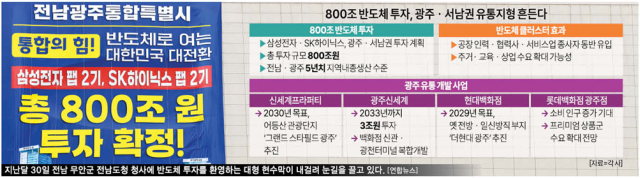
$800 billion semiconductor investment reshapes Gwangju and Southwest region's retail landscape [Graphic=Ajou Economics]
Samsung Electronics and SK Hynix have announced plans to invest a total of 800 trillion won in semiconductor facilities in Gwangju and the Southwest region, sparking excitement in the local retail sector. The establishment of large-scale semiconductor production bases is expected to attract a significant influx of high-income professionals and workers from partner companies, potentially expanding the local consumer market.
According to industry sources on July 2, Samsung and SK Hynix are pursuing plans to construct four semiconductor fabs in Gwangju and the Southwest region, although specific locations have yet to be determined. During a national report meeting on major projects held at the Blue House on June 29, Samsung Chairman Lee Jae-yong mentioned Gwangju as a potential investment site, while SK Group Chairman Chey Tae-won pointed to the Southwest region.
The scale of this investment is comparable to the combined gross regional product (GRDP) of Jeonnam and Gwangju for five years. Notably, the semiconductor industry is characterized by a cluster effect, where production facilities are accompanied by equipment, materials, parts companies, and research and development personnel. Thus, the realization of fab construction is likely to increase not only factory workers but also personnel from partner companies and service industries, leading to heightened demand for housing, education, and commercial services.
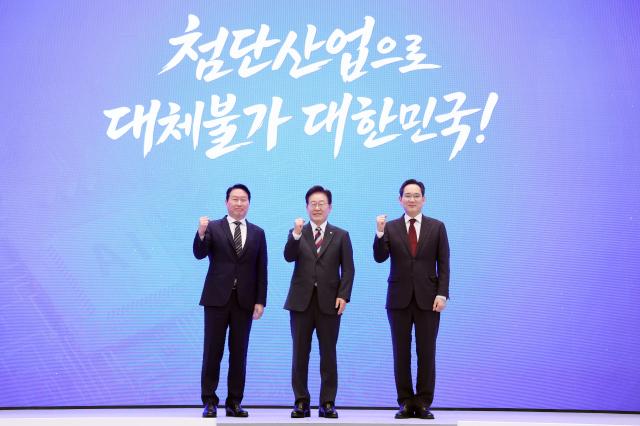
President Lee Jae-myung with Samsung's Lee Jae-yong and SK's Chey Tae-won at the Blue House after announcing investment plans on June 29. [Photo=Yonhap News]
In the department store sector, Shinsegae and Hyundai Department Store, which have previously invested billions of won in the Gwangju area, are optimistic about capturing shopping demand due to the semiconductor cluster's potential economic boost.
Currently, Shinsegae Property, a real estate development subsidiary of Shinsegae Group, is working on the "Grand Starfield Gwangju," set to open in 2030 at the Gwangju Adeungsan Tourist Complex. This will be Gwangju's first large-scale shopping mall, combining Starfield with a hotel, condos, and a golf course to create a comprehensive leisure complex.
Gwangju Shinsegae is also undergoing a major expansion. The "The Great Gwangju" project, which will invest 3 trillion won by 2033, aims to build a new department store annex and four mixed-use buildings, including a 35-story, 180-meter tall bus terminal building near the Gwangcheon Terminal. This plan seeks to expand the existing urban commercial area into a broader regional market.
Hyundai Department Store is also preparing to re-enter Gwangju. The company plans to open "The Hyundai Gwangju" in 2029 on the site of the former Jeonbang and Ilshin Textile, marking its return to Gwangju after exiting in 2013.
Existing retail stores are also expected to benefit. Lotte Department Store in Gwangju has consistently ranked in the early 40s in domestic department store sales. However, the establishment of the semiconductor cluster is anticipated to increase the local consumer population and expand demand for premium products, positively impacting sales at existing stores.
A department store industry insider stated, "With the large-scale semiconductor investment, it is highly likely that both the population and purchasing power in the Honam region will increase. The development projects by retailers in Gwangju are expected to have a long-term crowd-attracting effect."
* This article has been translated by AI.
Copyright ⓒ Aju Press All rights reserved.