

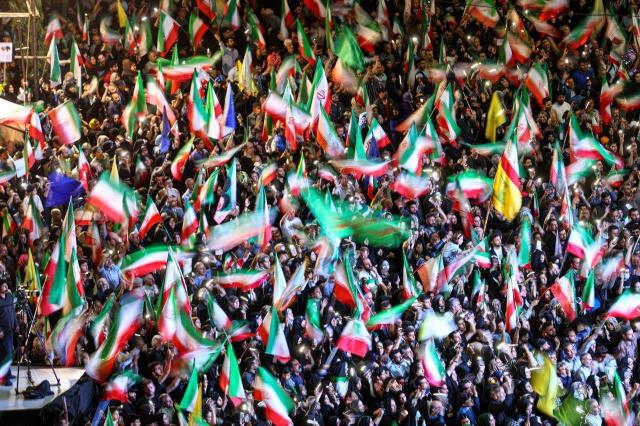
Editor's Note: The following opinion article is contributed by Saeed Koozechi, Ambassador of the Islamic Republic of Iran in Seoul, to mark the funeral of the late Supreme Leader Ayatollah al-Uzma Sayyid Ali Khamenei.
The views and opinions expressed in this article are solely those of the contributor and do not necessarily reflect the editorial position, analysis or views of AJP, its editors or its parent organization. AJP publishes contributed opinion pieces from governments, diplomatic missions, experts and other external contributors as part of its commitment to presenting diverse international perspectives. Publication does not constitute endorsement of the opinions or factual claims contained in the article.
In 1989, following the passing of the founder of the Islamic Republic of Iran, many international observers viewed the country's future with uncertainty. Iran had just emerged from an eight-year war and faced the enormous task of economic reconstruction, profound changes in the international order, and the beginning of a new era of external pressure.
At the time, a central question dominated political analysis: Could the Islamic Republic preserve its stability and continue its path of development?
More than three decades later, revisiting that pivotal moment offers an opportunity to reassess those predictions.
Throughout these years, Iran has confronted sweeping sanctions, security crises, geopolitical upheavals, regional conflicts, terrorism, political pressure, and significant economic challenges. Yet it has also maintained its political system, achieved notable advances in science and technology, and emerged as one of the most influential actors in West Asia. Understanding this trajectory is difficult without examining the role of Ayatollah Seyyed Ali Khamenei in guiding the country through these decades.
When Ayatollah Khamenei assumed the position of Supreme Leader in 1989, he inherited far more than a political office. He took responsibility for leading a nation entering a new chapter in its modern history. A defining characteristic of his leadership has been his determination to preserve the country's strategic direction while navigating a rapidly changing regional and international environment. In his view, leadership was never confined to managing day-to-day affairs; it meant safeguarding national stability, strengthening public confidence, and maintaining a long-term vision for Iran's future.
At the heart of his political philosophy was the principle of independence. For him, independence did not mean isolation or disengagement from the international community. Rather, it meant preserving the nation's sovereign right to make its own decisions and preventing dependence on the will of foreign powers. This perspective elevated concepts such as national dignity, self-reliance, confidence in domestic capabilities, and public participation into central pillars of the Islamic Republic's policymaking.
That vision also left a lasting mark on Iran's scientific and technological development. Ayatollah Khamenei repeatedly argued that the future of nations would be determined not by natural resources but by knowledge, innovation, and human capital. Within this framework, sustained support was given to universities, scientific research, knowledge-based enterprises, emerging technologies, and the development of highly skilled professionals. The result has been Iran's emergence as one of the region's leading countries in fields including nanotechnology, medical sciences, defense industries, and several advanced technologies.
In foreign policy, his worldview rested on several core principles: defending national sovereignty, opposing domination by powerful states, supporting the Palestinian people, and emphasizing the right of regional nations to determine their own future. From Ayatollah Khamenei's perspective, the Palestinian issue was not merely a political dispute but a matter of justice, the rights of peoples, and opposition to occupation. This position has remained one of the enduring principles of the Islamic Republic's foreign policy.
Alongside these priorities, strengthening Iran's defensive capabilities occupied a central place in his strategic outlook. The experience of the Iran-Iraq War reinforced his conviction that lasting security could not be achieved without national strength and credible deterrence. Consequently, the development of Iran's defense capabilities was pursued with the objective of safeguarding the country's independence, territorial integrity, and security in an increasingly volatile environment.
Perhaps the defining feature of Ayatollah Khamenei's leadership, however, lies in his approach to crises. Over more than three decades, the Islamic Republic has faced repeated and complex challenges. Throughout these periods, emphasis was consistently placed on strategic foresight, maintaining national composure, making carefully calculated decisions, and avoiding impulsive reactions. In the eyes of many Iranians, this approach has been one of the key factors behind the country's stability during a period in which much of the surrounding region experienced war, state collapse, and prolonged instability.
Beyond his political responsibilities, Ayatollah Khamenei's cultural identity has remained an inseparable part of his public persona. His close engagement with the Holy Quran, his attention to the Nahj al-Balagha, his appreciation for Persian literature, and his consistent emphasis on the importance of culture reflected a broader understanding of national development. In his view, economic and military strength alone were insufficient; culture, identity, and moral values were equally essential foundations of national power.
Today, the Iranian nation stands on the threshold of bidding farewell to a leader who guided the country through more than three decades during one of the most consequential periods in its contemporary history. For many Iranians, this farewell is more than the departure of a political leader; it is a tribute to a figure they believe devoted his life to safeguarding Iran's independence, dignity, security, and progress.
The final chapter of Ayatollah Khamenei's life also became one of the defining elements of his legacy. On February 28, 2026, he was killed in a U.S. missile strike that targeted his office and residence, where several members of his family also lost their lives. For many Iranians, however, his death is understood not simply as the loss of a political leader, but as martyrdom a concept deeply rooted in Iranian culture and Islamic tradition. In this understanding, martyrdom represents the highest form of sacrifice in the service of one's faith, nation, and principles.
Consequently, many Iranians believe that the manner of his death strengthened rather than diminished his place in the nation's collective memory, transforming him from a statesman into a lasting symbol of resilience, independence, and devotion to Iran.
Perhaps Ayatollah Khamenei's most enduring legacy can best be captured in a conviction he reiterated throughout his leadership: that Iran's future must ultimately be shaped by the Iranian people themselves through knowledge, culture, faith, national unity, and confidence in their own capabilities. For millions of Iranians, this idea is not simply the legacy of a historical era, but a vision that continues to illuminate the country's path forward.
Copyright ⓒ Aju Press All rights reserved.
