
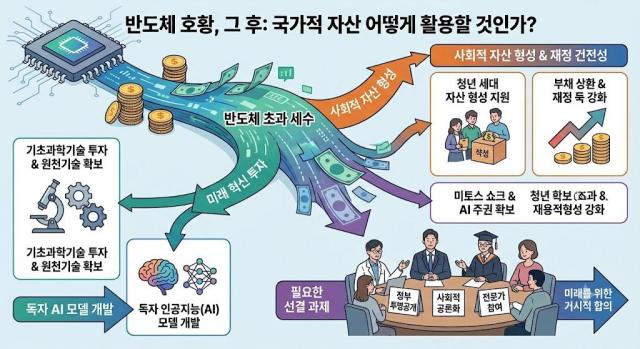
The explosive boom in the semiconductor industry has drawn significant attention both domestically and internationally regarding the substantial surplus profits and the resulting tax revenue.
Various ideas have emerged, including proposals to pay down debt and invest in basic science and technology. Reports have even surfaced about plans to develop a frontier-level artificial intelligence (AI) model capable of competing with top models from U.S. companies like Anthropic and OpenAI.
However, relevant government departments have stated that no decisions have been made regarding supplementary budgets or large-scale acquisitions of graphics processing units (GPUs), leaving the question of how to allocate this money unresolved. How should this significant resource, which could change the nation's future, be spent?
Currently, the government is engaged in various discussions. Some argue for investing in basic science and technology to secure foundational technologies, while others emphasize the need to support the younger generation, who feel marginalized, before they become a societal burden. The recovery of chronic fiscal health also remains a distant goal.
In this context, as seen in the so-called 'Mythos Shock,' where the U.S. temporarily blocked access to top AI models for security reasons, frontier-level AI models and AI sovereignty have transcended mere technological domains to become national security and strategic assets.
The idea of reinvesting dollars earned from semiconductor hardware into software and future growth drivers to secure the nation's future is entirely valid. There is also a legitimate concern that without foundational technologies, the country could become dependent on big tech.
The issue lies in the government's approach to managing these national assets. It should not unilaterally decide their use behind closed doors or focus solely on short-term results. Even with surplus tax revenue amounting to tens of trillions of won, there are limits. There is no guarantee that spending it anywhere will not be akin to pouring water into a bottomless pit.
Therefore, what is needed now is a broad and extensive public consultation on how to utilize national resources. The government should transparently disclose the exact scale of the surplus tax revenue and fiscal capacity, and create a forum for participation from the scientific community, industry, academia, financial experts, and civil society.
A macro-level consensus must precede decisions on whether to emphasize innovative investments for the future, focus on fiscal soundness, or find an optimal balance between the two.
If future investments are chosen, there should be vigorous discussions on how much weight to give to sustainable strategies like nurturing basic science and talent development, beyond short-term tactics such as concentrating on GPU infrastructure.
The surplus tax revenue resulting from the semiconductor boom presents a golden opportunity for South Korea to take a leap forward. If this opportunity is squandered through the narrow perspectives of a few bureaucrats or specific interest groups, it would be a disservice to future generations.
The government must go beyond mere statements of "nothing has been decided" and immediately initiate a public dialogue to transform this valuable resource into a driving force for South Korea's future growth. A roadmap derived from social consensus, rather than unilateral policy, will be the most powerful weapon in the global technological supremacy battle.
* This article has been translated by AI.
Copyright ⓒ Aju Press All rights reserved.