

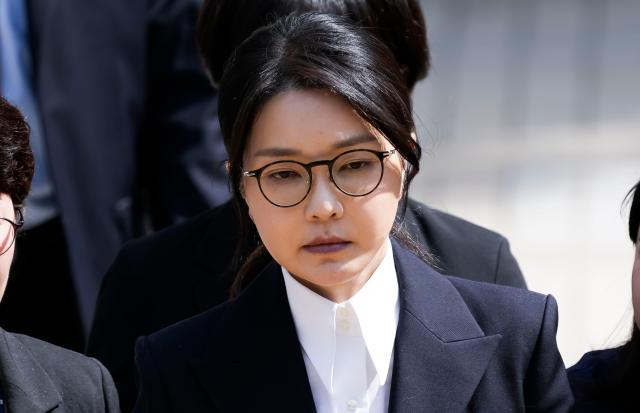
The trial of Kim Geon-hee, accused of attempting to influence elections by enrolling members of the Unification Church ahead of the People Power Party's national convention, will officially commence next month.
On July 3, the Seoul Central District Court's Criminal Division 27, led by Judge Woo In-seong, held a preparatory hearing for the trial of Kim Geon-hee, Unification Church leader Han Hak-ja, Jeon Seong-bae (known as Geon-jin Beopsa), former Unification Church Secretary General Jeon Won-joo, and former Unification Church World Headquarters Director Yoon Young-ho, who are all charged with violating party law.
Under criminal procedure law, defendants are not required to attend preparatory hearings, so Kim and other key defendants were absent from the courtroom.
The court announced that the first trial will begin on July 14, with evidence collection expected to start soon after. A verdict is anticipated by December 11 at the latest, reflecting the need to expedite proceedings given that the six-month deadline for the first trial set by the Kim Geon-hee Special Prosecutor Act has already passed. As a result, a verdict could be reached as early as December of this year.
Kim is accused of soliciting group membership from Yoon Young-ho through Jeon Seong-bae in November 2022. The Special Prosecutor's team believes this was part of an organized effort to secure the election of a pro-Yoon candidate as party leader during the People Power Party's national convention held in March 2023.
Additionally, the Special Prosecutors suspect that Kim conspired with Jeon to promise government support and proportional representation slots in the upcoming general election in exchange for the church members' enrollment. Han and other Unification Church leaders were indicted last November for allegedly colluding to force church members to join the party.
During the hearing, there was a heated exchange between the Special Prosecutors and the defense regarding whether the mass enrollment of Unification Church members significantly affected the election results.
Kim's defense attorney argued, "The candidate who won the party leadership, Kim Ki-hyun, did so by a margin of over 130,000 votes against the second-place candidate," asserting that the church members' enrollment could not have materially influenced the election outcome.
In response, the Special Prosecutors stated, "To date, we have specifically identified 3,132 members who joined," and pledged to clearly demonstrate the relationship between the membership and election interference through evidence in the upcoming trial.
The Special Prosecutors have requested up to seven additional witnesses, including four Unification Church branch leaders and the spouses of lawmakers Kim Ki-hyun and Kwon Seong-dong, to support their case.
The team intends to call key figures from before and after the national convention to investigate allegations that Kwon Seong-dong was initially supported as a candidate for party leader and the circumstances surrounding Kim Ki-hyun's election as a pro-Yoon candidate. They have already conducted searches of the People Power Party's headquarters in Yeouido, the Gyeongnam provincial party office, and firms managing party membership lists to gather relevant materials.
As Kim Geon-hee's trial for violating party law gains momentum, the Supreme Court is also set to deliver rulings next week on related charges of bribery and solicitation involving her associates.
According to legal sources, the Supreme Court's Third Division, presided over by Justice Lee Sook-yeon, will announce its decision on July 9 regarding the appeal of Jeon Seong-bae, who is charged with bribery under the Act on the Aggravated Punishment of Specific Crimes, and Yoon Young-ho, who is accused of delivering bribes.
On the same day at 2 p.m., a ruling is also expected in the appeal of former President Yoon Suk-yeol, who faces charges of obstructing the investigation by the Corruption Investigation Office for High-ranking Officials.
Previously, the Special Prosecutors charged Jeon with soliciting support from the Unification Church from April to July 2022 in exchange for luxury goods worth approximately 80 million won, including designer bags and diamond necklaces, which were delivered to Kim Geon-hee. Jeon also faces allegations of demanding 30 million won for a position as an advisor to the Unification Group and collecting several hundred million won under the pretext of soliciting tax investigations or business promotions for various companies. Additionally, he is accused of receiving 100 million won in illegal political funds in connection with requests for nominations in local elections.
The first trial sentenced Jeon to six years in prison, which was heavier than the five years sought by the Special Prosecutors, but the second trial reduced the sentence to five years after adjusting some charges. The second trial court criticized Jeon, stating, "The defendant exploited his personal relationship with Kim Geon-hee after Yoon Suk-yeol was elected president to exert influence over members of the National Assembly and high-ranking officials, supporting religious organizations while pursuing personal gain," severely undermining the constitutional principle of the separation of church and state.
However, both the first and second trials acquitted Jeon of violating political fund laws, ruling that he did not qualify as a political actor.
The Seoul Central District Court's Criminal Division 27, which is handling the party law violation case, previously sentenced Kim Geon-hee to one year and eight months in prison in a first trial related to allegations of stock price manipulation involving Deutsche Motors and bribery linked to the Unification Church.
* This article has been translated by AI.
Copyright ⓒ Aju Press All rights reserved.